Is a Trump victory also a victory for the technofeudalists?

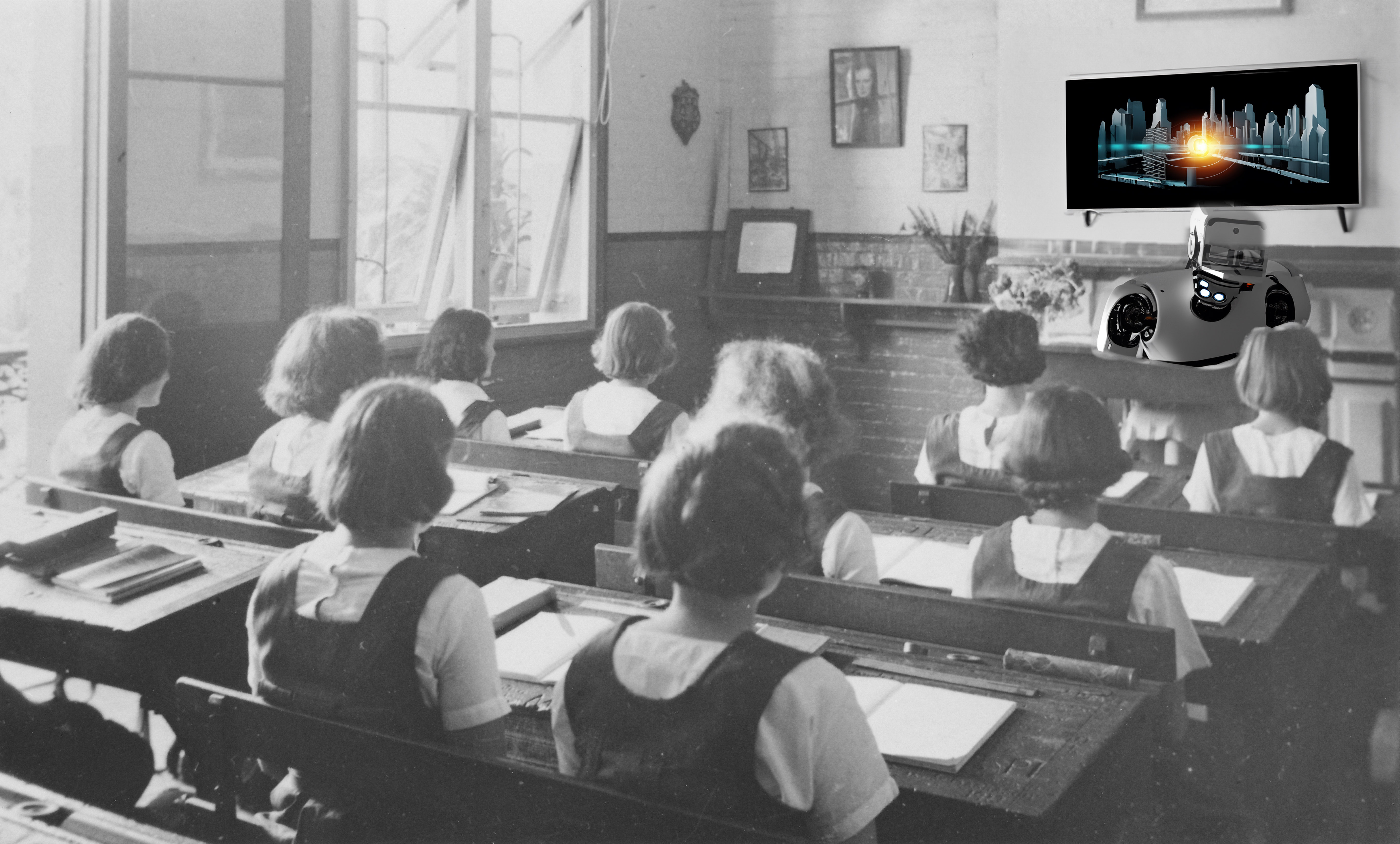
“This guy’s got my back” – Composite image created by author*

Under feudalism, the power of the ruling class grew out of owning land that the majority could not own, but were bonded to. Under capitalism, power stemmed from owning capital that the majority did not own, but had to work with to make a living. Under technofeudalism, a new ruling class draws power from owning cloud capital whose tentacles entangle everyone.” [1]

Trump’s victory in the 2024 US election on 5th November is sending shock waves around the globe. Although the world’s leaders are sending him nice congratulatory messages [2] one suspects they, and their advisors, are simultaneously wringing their hands wondering how they are going to counteract some of Trump’s more extreme rants and actions in the coming years.

Immediate concerns, at least amongst European (including UK) leaders are going to focus on Trump’s potential trade war with China, what he’ll do in Ukraine and the Middle East, what his policy will be towards NATO, as well as, probably most significantly, what the Republican’s stance on climate change will be. If Project 2025 does turn out to be a “wish list” for the party [3] then the threat to slash federal money for research and investment in renewable energy, and calls for the incoming president to “stop the war on oil and natural gas” may be about to be made real.

Whilst some commentators tell us that “Trump has killed the neoliberal order” [4] this is overly simplistic. I can understand why Americans do not want to preserve an economic system that does not reward them but I’m sure they will not be happy when tariffs on imported Chinese goods put up the cost of their cars, household electronics, clothes and their kids toys.

Remember also that one of the cornerstones of the neoliberal political philosophy is, through privatisation and austerity, to reduce the state influence on the economy. This is something that is very much at the heart of Project 2025 – namely, to“de-weaponize the federal government and dismantle the deep state”. Many Americans already suffer greatly from not having access to good quality, free at the point of access, healthcare. Although Trump stated he would not cut Social Security and Medicare his tax proposals would accelerate the date the Social Security Trust Fund runs out of money from 2034 to 2031 and deepen the cuts to benefits to about one third of their current levels [5].

What Project 2025 does seek to do is to privatise parts of the Medicare and Medicaid programs, which will affect poorer recipients more directly, and to impose work requirements for Medicaid. That would result in loss of coverage for many of the most desperate patients [6].

Whilst it seems that neoliberalism might not be completely dead under Trump, there is a far greater threat that his next presidency may bring. As it says in this posts opening quote from Yanis Varoufakis, technofeudalists are the new ruling class that draw their power from owning cloud capital whose tentacles entangle everyone. Well guess what, those tentacled feudalists have just taken on a whole new set of superpowers by entangling themselves with the soon to be United States government under the presidency of Donald J. Trump!

It was no coincidence that within hours of Kamala Harris conceding defeat to Trump, Tesla shares went up by over $35, Amazon by $5, Microsoft by $10 and Bitcoin went up by over $5,000 to a whopping $75,643 per Bitcoin. Whether voters realised it or not, a vote for Trump was a vote for the tech moguls whose billionaire-in-chief is Elon Musk, owner of Tesla, Space-X and, most significantly, the X social media platform.

When Musk bought what was then called Twitter for $44 billion in 2022 [7] most people thought he was mad and that he had overpaid for it with one analyst believing Twitter was really ‘only’ worth $30 billion [8]. It was also not clear why Musk wanted to diversify into social media, surely building electric cars and space rockets was enough?

But clearly not and now we know why.

Musk is the defacto uber-technofeudalist. He has made X his own personal fiefdom where, because he now owns it, he can literally do what he wants. Since buying the platform Musk has:

  • Complied with 808 of the 971 government demands to do things like remove controversial posts, as well as demands that X produce private data to identify anonymous accounts [9].
  • Prevented users from posting links to a newsletter containing a hacked document that’s alleged to be the Trump campaign’s research into vice presidential candidate JD Vance and suspended the journalist who wrote the newsletter [10].
  • Sued organisations who are attempting to fight disinformation thereby presenting a threat to the First Amendment [11].
  • Allowed both paid “Premium” subscriber accounts and thousands of unpaid accounts that support pro-Nazi content to stay on X violating the platforms own rules [12].

I could go on, but you get the picture.

To paraphrase The Guardian journalist George Monbiot, Trump’s victory and his promise to give Musk a top government job (to head up the government efficiency commission) may well allow him to escape the regulators by effectively making him “his own regulator”. Bear in mind as well that Musk controls key strategic and military assets, such as SpaceX satellite launchers and the Starlink internet system. It is not hard to see how his control over such assets could “grow to the point at which governments feel obliged to do as he demands“. [13]

Whilst on the subject of media platforms owned by technofeudalists we must not forget that august mainstream media publication The Washington Post owned by the world’s third richest man (following close on the heels of Musk), Jeff Bezos. Leading up to the US election the Post allegedly spiked an editorial endorsing Kamala Harris. This led to staff resignations as well as anger from its (and other) journalists as well as some 200,000 readers supposedly cancelling their subscriptions.

The Post’s publisher and chief executive, William Lewis, having a sudden epiphany, stated: “We are returning to our roots of not endorsing presidential candidates”, which it had been doing since 1976. Whilst this may be a justifiable and honourable position to take, the fact that this decision was made days before the election, when one of the candidates said he will take revenge on news organisations that anger him, smacked a bit arse-licking I would suggest. Whilst there was no suggestion that the non-endorsement was influenced by Jeff Bezos, it surely cannot be a coincidence that Amazon and Bezos’s space exploration company Blue Origin as well as Amazon Web Services (AWS) frequently bid for government contracts. As Alison Phillips says [14] “The non-endorsement may not have been Bezos’s decision, but good editors know instinctively what their masters want”.

So what does all this mean for us mere mortals that use the platforms owned by these ever more powerful, and rich, technofeudalists? Over to Varoufakis who explains the role of the users who service these cloud fiefdoms as being one of two types [15]:

  1. The cloud proles who are the workers driven to their physical limits by algorithms that control their every working hour and who provide the physical services that the cloud platform’s require. These are the Uber drivers, the Amazon warehouse and delivery workers, the Deliveroo cyclists who buzz around our cities delivering burgers and pizzas and the myriad of content checkers whose job it is to weed out some of the appalling violent, pornographic, racist and misogynistic content from social media platforms in the vain hope it will not be seen by decent God-fearing folk (which it often still is).
  2. The cloud serfs are the people (and that’s several billion people around the world) who provide the content (the raw tracking data, the stories, the videos, the images) largely for free, that enable these platforms to be more than just the server farms, networks and software from which they are built.

The genius of the technofeudalists, whether through foresight or opportunism, has been to intertwine themselves so tightly with government that they are no longer relatively benign providers of services (data centres, satellites, CCTV cameras and so on) but an integral and fundamental part of the whole machinery of government. This is both in the control they exert during the elections when our leaders are voted in as well as during the day-to-day running of government where they provide much of the machinery that allows surveillance capitalism to take place. Varoufakis again:

Under technofeudalism, we no longer own our minds. Every proletarian is turning into a cloud prole during working hours and into a cloud serf the rest of the time. Every self-employed striver mutates into a cloud vassal, while every self-employed struggler becomes a cloud serf. While privatisation and private equity asset-strip all physical wealth around us, cloud capital goes about the business of asset-stripping our brains” [16].

This is what Alex Gourevitch refers to as anti-democratic power. The technofeudalists rule us without ruling through politics. Instead they rule us through their economic power. What they decide to invest in, whether it be machine learning, blockchain, space travel, virtual reality glasses or self-driving cars, decides what our entertainment, our social interactions and our cultural future will be like [17].

With the buddying up of the technofeudalists to autocracies, like the new Trump government promises to be, these gatekeepers are gaining even more power, influence and control over our lives – the kind of control that was once a work of dystopian fiction by an English author called George Orwell. It’s beginning to look like Orwell was right all along, he was just 40 years too early in his prediction [18]. The ‘2024’ version of ‘1984’ is one in which a few billionaires living on the West coast of America are the protagonists. Their goals are not about providing better lives for citizens but lining their own pockets whilst at the same time enjoying the fruits of the enormous power bestowed up them by autocratic leaders like Trump.

As Orwell warned, dictatorships don’t just arise from brutality and suppression. They arise from control of information and the platforms that control that information [19]. For him it was doublethink: famine is plenty, war is peace. For us it’s fake news and alternative facts.

How ordinary citizens can react to this and what can be done about it seems to be impossibly hard to answer questions right now. The renowned critic of cryptocurrencies and blockchain-based projects Molly White in her newsletter [citation needed] makes an attempt to at least part address these questions [20], for example:

  • Consider reducing your reliance on centralized social networks controlled by billionaires, and instead establishing a web presence you control.
  • Find and support trusted sources of news and information. If you rely heavily on mainstream news outlets owned by billionaires who aided Trump in his victory, consider diversifying your media diet.
  • Use end-to-end-encrypted messaging apps for your communications and consider using a VPN to help protect your privacy online.

However if we are to try and “wind the clock” we are going to have to do far, far more. What and how is something I plan to explore in future posts.

*I’m trying to avoid using AI generated imagery in these posts preferring to create composites like this one in the style of Cold War Steve.


Notes

  1. Technofeudalism – What Killed Capitalism, Yanis Varoufakis, The Bodley Head, 2023, p215.
  2. Netanyahu and Starmer lead congratulations to Trump, Gianluca Avagnina https://www.bbc.co.uk/news/articles/cly2z812zxvo
  3. Project 2025: The right-wing wish list for another Trump presidency, Mike Wendling, https://www.bbc.co.uk/news/articles/c977njnvq2do
  4. Trump has killed the neoliberal order, Richard Murphy https://www.taxresearch.org.uk/Blog/2024/11/06/trump-has-killed-the-neoliberal-order/
  5. Fact check: Does trump intend to cut social security and medicare?, Christine Sellers, https://checkyourfact.com/2024/10/24/fact-check-trump-cut-social-security-medicare/
  6. It’s Find Out Time, Jay Kuo, https://substack.com/home/post/p-151381890
  7. Elon Musk takes control of Twitter in $44bn deal, James Clayton & Peter Hoskins, https://www.bbc.co.uk/news/technology-63402338
  8. Elon Musk’s X is worth nearly 80% less than when he bought it, Fidelity estimates, Matt Egan, https://edition.cnn.com/2024/10/02/business/elon-musk-twitter-x-fidelity/index.html
  9. Twitter is complying with more government demands under Elon Musk, Russell Brandom, https://restofworld.org/2023/elon-musk-twitter-government-orders/
  10. X blocks links to hacked JD Vance dossier, Elizabeth Lopatto, https://www.theverge.com/2024/9/26/24255298/elon-musk-x-blocks-jd-vance-dossier
  11. Elon Musk’s Supreme Court Endgame in Defamation Lawsuit, Rebecca Buckwalter-Poza, https://slate.com/news-and-politics/2024/03/elon-musk-media-matters-supreme-court.html
  12. Verified pro-Nazi X accounts flourish under Elon Musk, David Ingram, https://www.nbcnews.com/tech/social-media/x-twitter-elon-musk-nazi-extremist-white-nationalist-accounts-rcna145020
  13. Can democracy survive now the world’s richest man has it in his sights?, George Monbiot, https://www.theguardian.com/commentisfree/2024/nov/02/elon-musk-donald-trump-us-presidential-elections
  14. The cowardice of the Washington Post, Alison Phillips, https://www.newstatesman.com/comment/2024/10/cowardice-washington-post-kamala-harris
  15. Technofeudalism – What Killed Capitalism, Yanis Varoufakis, The Bodley Head, 2023, p80 – 85.
  16. Ibid, p213.
  17. The Machiavellis of the market: Entrepreneurs against democracy, Alex Gourevitch, https://lpeproject.org/blog/the-machiavellis-of-the-market-entrepreneurs-against-democracy/
  18. The ‘foolproof’ election forecaster who predicted Trump would lose – what went wrong?, David Smith, https://www.theguardian.com/us-news/2024/nov/16/trump-election-forecast-allan-lichtman
  19. Welcome to dystopia – George Orwell experts on Donald Trump, Jean Seaton, Tim Crook and DJ Taylor, https://www.theguardian.com/commentisfree/2017/jan/25/george-orwell-donald-trump-kellyanne-conway-1984
  20. Wind the clock, Molly White, https://www.citationneeded.news/wind-the-clock/

Why the blogosphere still matters

John Naughton in his weekly Observer column raises an interesting point in a recent opinion piece. For many, the internet, or more specifically the ‘web’ and what it has morphed into has become little more than a proliferation of walled gardens owned by the likes of Google, X, Facebook and Substack for whom “free speech is something that is algorithmically curated while the speakers are intensively surveilled and their is data mined for advertising purposes”.

He reminds us that before all of these horticultural abominations arose on the back of what we now call Web 2.0 there was a truly safe, open space known as the blogosphere that could genuinely be a modern realisation of something Jürgen Habermas’s called the “the public sphere” because it was open to all, everything was discussable and social rank didn’t determine who was allowed to speak.

Naughton’s column has made me want to revisit this blog as I realise the importance of the freedom to own my own opinions and ideas and not have them filtered and surveilled by the very tech overlords who I despise and continue to be the antithesis of what an open and democratic web should be about.

Now is an even more important time for those of us with any kind of tech background and knowledge to be raising up against those people (the so-called tech bro’s) who want to create the world according to their own particular vision and who have managed to monopolise the very platforms who most people use to try and articulate their thoughts and their ideas.

Treat this as the start of a revival of Software Architecture Zen where I will attempt to help cut through the tech-hype we are being bombarded with and deliver a more rational and realistic view on where technology may be taking us.

To paraphrase a well known (tech) TV commercial – let’s try and see how 2024 does not need to be like 1984.

Why it’s different this time

Image Created Using Adobe Photoshop and Firefly

John Templeton, the American-born British stock investor, once said: “The four most expensive words in the English language are, ‘This time it’s different.’”

Templeton was referring to people and institutions who had invested in the next ‘big thing’ believing that this time it was different, the bubble could not possibly burst and their investments were sure to be safe. But then, for whatever reason, the bubble did burst and fortunes were lost.

Take as an example the tech boom of the late 1980s and 1990s. Previously unimagined technologies that no one could ever see any sign of failing meant investors poured their money into this boom. Then it all collapsed and many fortunes were lost as the Nasdaq dropped 75 percent.

It seems to be an immutable law of economics that busts will follow booms as sure as night follows day. The trick then is to predict the boom and exit your investment at the right time – not too soon and not too late, to paraphrase Goldilocks.

Most recently the phrase “this time it’s different” is being applied to the wave of AI technology which has been hitting our shores, especially since the widespread release of large language model technologies which current AI tools like OpenAI’s ChatGPT, Google’s PaLM, and Meta’s LLaMA use as their underpinning.

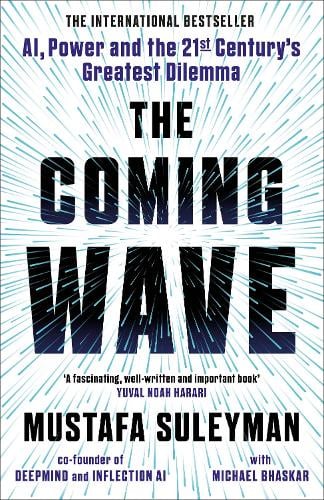
Which brings me to the book The Coming Wave by Mustafa Suleyman.

Suleyman was the co-founder of DeepMind (now owned by Google) and is currently CEO of Inflection an AI ‘studio’ that, according to its company blurb is “creating a personal AI for everyone”.

The Coming Wave provides us with an overview not just of the capabilities of current AI systems but also contains a warning which Suleyman refers to as the containment problem. If our future is to depend on AI technology (which it increasingly looks like it will given that, according to Suleyman, LLMs are the “fastest, diffusing consumer models we have ever seen“) how do you make it a force for good rather than evil whereby a bunch of ‘bad actors’ could imperil our very existence? In other words, how do you monitor, control and limit (or even prevent) this technology?

Suleyman’s central premise in this book is that the coming technological wave of AI is different from any that have gone before for five reasons which makes containment very difficult (if not impossible). In summary, these are:

  • Reason #1: Asymmetry – the potential imbalances or disparities caused by artificial intelligence systems being able to transfer extreme power from state to individual actors.
  • Reason #2: Exponentiality – the phenomenon where the capabilities of AI systems, such as processing power, data storage, or problem-solving ability, increase at an accelerating pace over time. This rapid growth is often driven by breakthroughs in algorithms, hardware, and the availability of large datasets.
  • Reason #3: Generality – the ability of an artificial intelligence system to apply their knowledge, skills, or capabilities across a wide range of tasks or domains.
  • Reason #4: Autonomy – the ability of an artificial intelligence system or agent to operate and make decisions independently, without direct human intervention.
  • Reason #5: Technological Hegemony – the malignant concentrations of power that inhibit innovation in the public interest, distort our information systems, and threaten our national security.

Suleyman’s book goes into each of these attributes in detail and I do not intend to repeat any of that here (buy the book or watch his explainer video). Suffice it to say however that collectively these attributes mean that this technology is about to deliver us nothing less than a radical proliferation of power which, if unchecked, could lead to one of two possible (and equally undesirable) outcomes:.

  1. A surveillance state (which China is currently building and exporting).
  2. An eventual catastrophe born of runaway development.

Other technologies have had one or maybe two of these capabilities but I don’t believe any have had all five, certainly at the level AI has. For example electricity was a general purpose technology with multiple applications but even now individuals cannot build their own generators (easily) and there is certainly not any autonomy in power generation. The internet comes closest to having all five attributes but it is not currently autonomous (though AI itself threatens to change that).

To be fair, Suleyman does not just present us with what, by any measure, is a truly wicked problem he also offers a ten point plan for for how we might begin to address the containment problem and at least dilute the effects the coming wave might have. These stretch from including built in safety measures to prevent AI from acting autonomously in an uncontrolled fashion through regulation by governments right up to cultivating a culture around this technology that treats it with caution from the outset rather than adopting the move fast and break things philosophy of Mark Zuckerberg. Again, get the book to find out more about what these measures might involve.

My more immediate concerns are not based solely on the five features described in The Coming Wave but on a sixth feature I have observed which I believe is equally important and increasingly overlooked by our rush to embrace AI. This is:

  • Reason #6: Techno-paralysis – the state of being overwhelmed or paralysed by the rapid pace of technological change caused by technology systems.

As is the case of the impact of the five features of Suleyman’s coming wave I see two, equally undesirable outcomes of techno-paralysis:

  1. People become so overwhelmed and fearful because of their lack of understanding of these technological changes they choose to withdraw from their use entirely. Maybe not just “dropping out” in an attempt to return to what they see as a better world, one where they had more control, but by violently protesting and attacking the people and the organisations they see as being responsible for this “progress”. I’m talking the Luddites here but on a scale that can be achieved using the organisational capabilities of our hyper-connected world.
  2. Rather than fighting against techno-paralysis we become irretrevably sucked into the systems that are creating and propagating these new technologies and, to coin a phrase, “drink the Kool-Aid”. The former Greek finance minister and maverick economist Yanis Varoufakis, refers to these systems, and the companies behind them, as the technofeudalists. We have become subservient to these tech overlords (i.e. Amazon, Alphabet, Apple, Meta and Microsoft) by handing over our data to their cloud spaces. By spending all of our time scrolling and browsing digital media we are acting as ‘cloud-serfs’ — working as unpaid producers of data to disproportionately benefit these digital overlords.

There is a reason why the big-five tech overlords are spending hundreds of billions of dollars between them on AI research, LLM training and acquisitions. For each of them this is the next beachhead that must be conquered and occupied, the spoils of which will be huge for those who get there first. Not just in terms of potential revenue but also in terms of new cloud-serfs captured. We run the risk of AI being the new tool of choice in weaponising the cloud to capture larger portions of our time in servitude to these companies who produce evermore ingenious ways of controlling our thoughts, actions and minds.

So how might we deal with this potentially undesirable outcome of the coming wave of AI? Surely it has to be through education? Not just of our children but of everyone who has a vested interest in a future where we control our AI and not the other way round.

Last November the UK governments Department for Education (DfE) released the results from a Call for Evidence on the use of GenAI in education. The report highlighted the following benefits:

  • Freeing up teacher time (e.g. on administrative tasks) to focus on better student interaction.
  • Improving teaching and education materials to aid creativity by suggesting new ideas and approaches to teaching.
  • Helping with assessment and marking.
  • Adaptive teaching by analysing students’ performance and pace, and to tailor educational materials accordingly.
  • Better accessibility and inclusion e.g. for SEND students, teaching materials could be more easily and quickly differentiated for their specific.

whilst also highlighting some potential risks including:

  • An over reliance on AI tools (by students and staff) which would compromise their knowledge and skill development by encouraging them to passively consume information.
  • Tendency of GenAI tools to produce inaccurate, biased and harmful outputs.
  • Potential for plagiarism and damage to academic integrity.
  • Danger that AI will be used for the replacement or undermining of teachers.
  • Exacerbation of digital divides and problems of teaching AI literacy in such a fast changing field.

I believe that to address these concerns effectively, legislators should consider implementing the following seven point plan:

  1. Regulatory Framework: Establish a regulatory framework that outlines the ethical and responsible use of AI in education. This framework should address issues such as data privacy, algorithm transparency, and accountability for AI systems deployed in educational settings.
  2. Teacher Training and Support: Provide professional development opportunities and resources for educators to effectively integrate AI tools into their teaching practices. Emphasize the importance of maintaining a balance between AI-assisted instruction and traditional teaching methods to ensure active student engagement and critical thinking.
  3. Quality Assurance: Implement mechanisms for evaluating the accuracy, bias, and reliability of AI-generated content and assessments. Encourage the use of diverse datasets and algorithms to mitigate the risk of producing biased or harmful outputs.
  4. Promotion of AI Literacy: Integrate AI literacy education into the curriculum to equip students with the knowledge and skills needed to understand, evaluate, and interact with AI technologies responsibly. Foster a culture of critical thinking and digital citizenship to empower students to navigate the complexities of the digital world.
  5. Collaboration with Industry and Research: Foster collaboration between policymakers, educators, researchers, and industry stakeholders to promote innovation and address emerging challenges in AI education. Support initiatives that facilitate knowledge sharing, research partnerships, and technology development to advance the field of AI in education.
  6. Inclusive Access: Ensure equitable access to AI technologies and resources for all students, regardless of their gender, socioeconomic background or learning abilities. Invest in infrastructure and initiatives to bridge the digital divide and provide support for students with special educational needs and disabilities (SEND) to benefit from AI-enabled educational tools.
  7. Continuous Monitoring and Evaluation: Regularly monitor and evaluate the implementation of AI in education to identify potential risks, challenges, and opportunities for improvement. Collect feedback from stakeholders, including students, teachers, parents, and educational institutions, to inform evidence-based policymaking and decision-making processes.

The coming AI wave cannot be another technology that we let wash over and envelop us. Indeed Suleyman himself towards the end of his book makes the following observations…

Technologists cannot be distant, disconnected architects of the future, listening only to themselves.

Technologists must also be credible critics who…
…must be practitioners. Building the right technology, having the practical means to change its course, not just observing and commenting, but actively showing the way, making the change, effecting the necessary actions at source, means critics need to be involved.

If we are to avoid widespread techno-paralysis caused by this coming wave than we need a 21st century education system that is capable of creating digital citizens that can live and work in this brave new world.

Enchanting Minds and Machines – Ada Lovelace, Mary Shelley and the Birth of Computing and Artificial Intelligence

Today (10th October 2023) is Ada Lovelace Day. In this blog post I discuss why Ada Lovelace (and indeed Mary Shelley who was indirectly connected to Ada) is as relevant today as she was then.

Villa Diodati, Switzerland

In the summer of 1816 [1], five young people holidaying at the Villa Diodati near Lake Geneva in Switzerland found their vacation rudely interrupted by a torrential downfall which trapped them indoors. Faced with the monotony of confinement, one member of the group proposed an ingenious idea to break the boredom: each of them should write a supernatural tale to captivate the others.

Among these five individuals were some notable figures of their time. Lord Byron, the celebrated English poet and his friend and fellow poet, Percy Shelley. Alongside them was Shelley’s wife, Mary, her stepsister Claire Clairmont, who happened to be Byron’s mistress, and Byron’s physician, Dr. Polidori.

Lord Byron, burdened by the legal disputes surrounding his divorce and the financial arrangements for his newborn daughter, Ada, found it impossible to fully engage in the challenge (despite having suggested it). However, both Dr. Polidori and Mary Shelley embraced the task with fervor, creating stories that not only survived the holiday but continue to thrive today. Polidori’s tale would later appear as Vampyre – A Tale, serving as the precursor to many of the modern vampire movies and TV programmes we know today. Mary Shelley’s story, which had come to her in a haunting nightmare that very night, gave birth to the core concept of Frankenstein, published in 1818 as Frankenstein: or, The Modern Prometheus. As Jeanette Winterson asserts in her book 12 Bytes [2], Frankenstein is not just a story about “the world’s most famous monster; it’s a message in a bottle.” We’ll see why this message resounds even more today, later.

First though, we must shift our focus to another side of Lord Byron’s tumultuous life and his divorce settlement with his wife, Anabella Wentworth. In this settlement, Byron expressed his desire to shield his daughter from the allure of poetry—an inclination that suited Anabella perfectly, as one poet in the family was more than sufficient for her. Instead, young Ada received a mathematics tutor, whose duty extended beyond teaching mathematics and included eradicating any poetic inclinations Ada might have inherited. Could this be an early instance of the enforced segregation between the arts and STEM disciplines, I wonder?

Ada excelled in mathematics, and her exceptional abilities, combined with her family connections, earned her an invitation, at the age of 17, to a London soirée hosted by Charles Babbage, the Lucasian Professor of Mathematics at Cambridge. Within Babbage’s drawing room, Ada encountered a model of his “Difference Engine,” a contraption that so enraptured her, she spent the evening engrossed in conversation with Babbage about its intricacies. Babbage, in turn, was elated to have found someone who shared his enthusiasm for his machine and generously shared his plans with Ada. He later extended an invitation for her to collaborate with him on the successor to the machine, known as the “Analytical Engine”.

A Model of Charles Babbage’s Analytical Engine

This visionary contraption boasted the radical notion of programmability, utilising punched cards like those employed in weaving machines of that era. In 1842, Ada Lovelace (as she had become by then) was tasked with translating a French transcript of one of Babbage’s lectures into English. However, Ada went above and beyond mere translation, infusing the document with her own groundbreaking ideas about Babbage’s computing machine. These contributions proved to be more extensive and profound than the original transcript itself, solidifying Ada Lovelace’s place in history as a pioneer in the realm of computer science and mathematics.

In one of these notes, she wrote an ‘algorithm’ for the Analytical Engine to compute Bernoulli numbers, the first published algorithm (AKA computer program) ever! Although Babbage’s engine was too far ahead of its time and could not be built using current day technology, Ada is still credited as being the world’s first computer programmer. But there is another twist to this story that brings us closer to the present day.

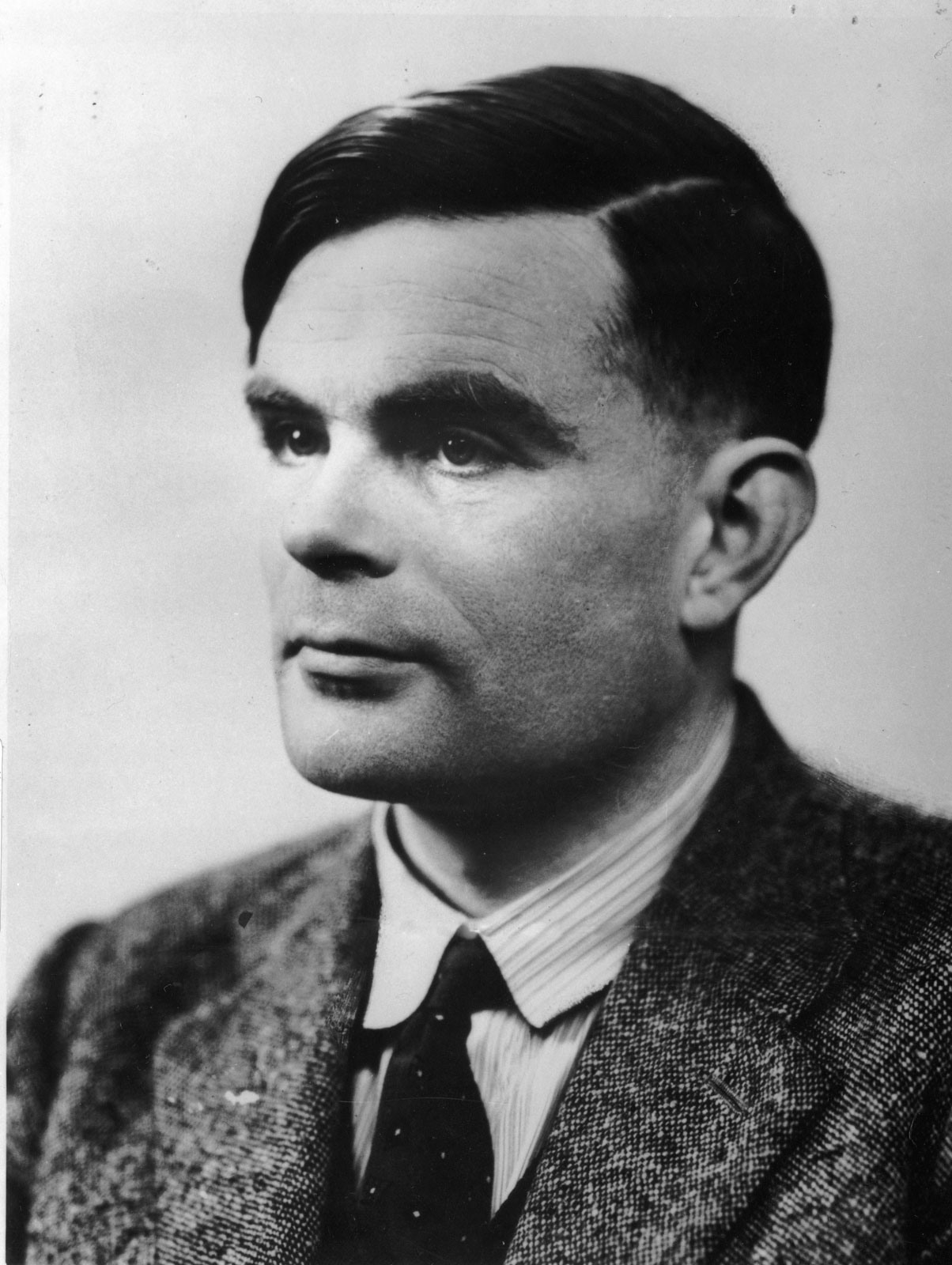
Fast forward to the University of Manchester, 1950. Alan Turing, the now feted but ultimately doomed mathematician who led the team that cracked intercepted, coded messages sent by the German navy in WWII, has just published a paper called Computing Machinery and Intelligence [3]. This was one of the first papers ever written on artificial intelligence (AI) and it opens with the bold premise: “I propose to consider the question, ‘Can machines think?”.

Alan Turing

Turing did indeed believe computers would one day (he thought in about 50 years’ time in the year 2000) be able to think and devised his famous “Turing Test” as a way of verifying his proposition. In his paper Turing also felt the need to “refute” arguments he thought might be made against his bold claim, including one made by no other than Ada Lovelace over one hundred years earlier. In the same notes where she wrote the world’s first computer algorithm, Lovelace also said:

It is desirable to guard against the possibility of exaggerated ideas that might arise as to the powers of the Analytical Engine. The Analytical Engine has no pretensions whatever to originate anything. It can do whatever we know how to order it to perform. It can follow analysis, but it has no power of anticipating any analytical relations or truths”.

Although Lovelace might have been optimistic about the power of the Analytical Engine, should it ever be built, the possibility of it thinking creatively wasn’t one of the things she thought it would excel at.

Turing disputed Lovelace’s view because she could have had no idea of the enormous speed and storage capacity of modern (remember this was 1950) computers, making them a match for that of the human brain, and thus, like the brain, capable of processing their stored information to arrive at sometimes “surprising” conclusions. To quote Turing directly from his paper:

It is a line of argument we must consider closed, but it is perhaps worth remarking that the appreciation of something as surprising requires as much of a ‘ creative mental act ‘ whether the surprising event originates from a man, a book, a machine or anything else.”

Which brings us bang up to date with the current arguments that are raging about whether systems like ChatGPT, DALL-E or Midjourney are creative or even sentient in some way. Has Turing’s prophesy finally been fulfilled or was Ada Lovelace right all along, computers can never be truly creative because creativity requires not just a reconfiguration of what someone else has made, it requires original thought based on actual human experience?

One undeniable truth prevails in this narrative: Ada was good at working with what she didn’t have. Not only was Babbage unable to build his machine, meaning Lovelace never had one to play with, she also didn’t have male privilege or a formal education – something that was a scarce commodity for women – a stark reminder of the limitations imposed on her gender during that time.

Have things moved on today for women and young girls? A glimpse into the typical composition of a computer science classroom, be it at the secondary or tertiary level, might beg the question: Have we truly evolved beyond the constraints of the past? And if not, why does this gender imbalance persist?

Over the past five or more years there have been many studies and reports published into the problem of too few women entering STEM careers and we seem to be gradually focusing in on not just what the core issues are, but also how to address them. What seems to be lacking is the will, or the funding (or both) to make it happen.

So, what to do, first some facts:

  1. Girls lose interest in STEM as they get older. A report from Microsoft back in 2018 found that confidence in coding wanes as girls get older, highlighting the need to connect STEM subjects to real-world people and problems by tapping into girls’ desire to be creative [4].
  2. Girls and young women do not associate STEM jobs with being creative. Most girls and young women describe themselves as being creative and want to pursue a career that helps the world. They do not associate STEM jobs as doing either of these things [4].
  3. Female students rarely consider a career in technology as their first choice. Only 27% of female students say they would consider a career in technology, compared to 61% of males, and only 3% say it is their first choice [5].
  4. Most students (male and female) can’t name a famous female working in technology. A lack of female role models is also reinforcing the perception that a technology career isn’t for them. Only 22% of students can name a famous female working in technology. Whereas two thirds can name a famous man [5].
  5. Female pupils feel STEM subjects, though highly paid, are not ‘for them’. Female Key Stage 4 pupils perceived that studying STEM subjects was potentially a more lucrative choice in terms of employment. However, when compared to male pupils, they enjoyed other subjects (e.g., arts and English) more [6].

The solutions to these issues are now well understood:

  1. Increasing the number of STEM mentors and role models – including parents – to help build young girls’ confidence that they can succeed in STEM. Girls who are encouraged by their parents are twice as likely to stay in STEM, and in some areas like computer science, dads can have a greater influence on their daughters than mums yet are less likely than mothers to talk to their daughters about STEM.
  2. Creating inclusive classrooms and workplaces that value female opinions. It’s important to celebrate the stories of women who are in STEM right now, today.
  3. Providing teachers with more engaging and relatable STEM curriculum, such as 3D and hands-on projects, the kinds of activities that have proven to help keep girls’ interest in STEM over the long haul.
  4. Multiple interventions, starting early and carrying on throughout school, are important ways of ensuring girls stay connected to STEM subjects. Interventions are ideally done by external people working in STEM who can repeatedly reinforce key messages about the benefits of working in this area. These people should also be able to explain the importance of creativity and how working in STEM can change the world for the better [7].
  5. Schoolchildren (all genders) should be taught to understand how thinking works, from neuroscience to cultural conditioning; how to observe and interrogate their thought processes; and how and why they might become vulnerable to disinformation and exploitation. Self-awareness could turn out to be the most important topic of all [8].

Before we finish, let’s return to that “message in a bottle” that Mary Shelley sent out to the world over two hundred years ago. As Jeanette Winterson points out:

Mary Shelley maybe closer to the world that is to become than either Ada Lovelace or Alan Turing. A new kind of life form may not need to be human-like at all and that’s something that is achingly, heartbreakingly, clear in ‘Frankenstein’. The monster was originally designed to be like us. He isn’t and can’t be. Is that the message we need to hear?” [2].

If we are to heed Shelley’s message from the past, the rapidly evolving nature of AI means we need people from as diverse a set of backgrounds as possible. These should include people who can bring constructive criticism to the way technology is developed and who have a deeper understanding of what people really need rather than what they think they want from their tech. Women must become essential players in this. Not just in developing, but also guiding and critiquing the adoption and use of this technology. As Mustafa Suleyman (co-founder of DeepMind) says in his book The Coming Wave [10]:

Credible critics must be practitioners. Building the right technology, having the practical means to change its course, not just observing and commenting, but actively showing the way, making the change, effecting the necessary actions at source, means critics need to be involved.

As we move away from the mathematical nature of computing and programming to one driven by so called descriptive programming [9] it is going to be important we include those who are not technical but are creative as well as empathetic to people’s needs and maybe even understand the limits we should place on technology. The four C’s (creativity, critical thinking, collaboration and communications) are skills we all need to be adopting and are ones which women in particular seem to excel at.

On this, Ada Lovelace Day 2023, we should not just celebrate Ada’s achievements all those years ago but also recognize how Ada ignored and fought back against the prejudices and severe restrictions on education that women like her faced. Ada pushed ahead regardless and became a true pioneer and founder of a whole industry that did not actually really get going until over 100 years after her pioneering work. Ada, the world’s first computer programmer, should be the role model par excellence that all girls and young women look to for inspiration, not just today but for years to come.

References

  1. Mary Shelley, Frankenstein and the Villa Diodati, https://www.bl.uk/romantics-and-victorians/articles/mary-shelley-frankenstein-and-the-villa-diodati
  2. 12 Bytes – How artificial intelligence will change the way we live and love, Jeanette Winterson, Vintage, 2022.
  3. Computing Machinery and Intelligence, A. M. Turing, Mind, Vol. 59, No. 236. (October 1950), https://www.cs.mcgill.ca/~dprecup/courses/AI/Materials/turing1950.pdf
  4. Why do girls lose interest in STEM? New research has some answers — and what we can do about it, Microsoft, 13th March 2018, https://news.microsoft.com/features/why-do-girls-lose-interest-in-stem-new-research-has-some-answers-and-what-we-can-do-about-it/
  5. Women in Tech- Time to close the gender gap, PwC, https://www.pwc.co.uk/who-we-are/her-tech-talent/time-to-close-the-gender-gap.html
  6. Attitudes towards STEM subjects by gender at KS4, Department for Education, February 2019, https://assets.publishing.service.gov.uk/government/uploads/system/uploads/attachment_data/file/913311/Attitudes_towards_STEM_subjects_by_gender_at_KS4.pdf
  7. Applying Behavioural Insights to increase female students’ uptake of STEM subjects at A Level, Department for Education, November 2020, https://assets.publishing.service.gov.uk/government/uploads/system/uploads/attachment_data/file/938848/Applying_Behavioural_Insights_to_increase_female_students__uptake_of_STEM_subjects_at_A_Level.pdf
  8. How we can teach children so they survive AI – and cope with whatever comes next, George Monbiot, The Guardian, 8th July 2023, https://www.theguardian.com/commentisfree/2023/jul/08/teach-children-survive-ai
  9. Prompt Engineering, Microsoft, 23rd May 2023, https://learn.microsoft.com/en-us/semantic-kernel/prompt-engineering/
  10. The Coming Wave, Mustafa Suleyman, The Bodley Head, 2023.

Machines like us? – Part II

Brain image by Elisa from Pixabay. Composition by the author

[Creativity is] the relationship between a human being and the mysteries of inspiration.

Elizabeth Gilbert – Big Magic

Another week and another letter from a group of artificial intelligence (AI) experts and public figures expressing their concern about the risk of AI. This one has really gone mainstream with Channel 4 News here in the UK having it as their lead story on their 7pm broadcast. They even managed to get Max Tegmark as well as Tony Cohn – professor of automated reasoning at the University of Leeds – on the programme to discuss this “risk of extinction”.

Whilst I am really pleased that the risks from AI are finally being discussed we must be careful not to focus too much on the Terminator-like existential threat that some people are predicting if we don’t mitigate against them in some way. There are certainly some scenarios which could lead to an artificial general intelligence (AGI) causing destruction on a large scale but I don’t believe these are imminent and as likely to happen as the death and destruction likely to be caused by pandemics, climate change or nuclear war. Instead, some of the more likely negative impacts of AGI might be:

It’s worth pointing out that all of the above scenarios do not involve AI’s suddenly deciding themselves they are going to wreak havoc and destruction but would involve humans being somewhere in the loop that initiates such actions.

It’s also worth noting that there are fairly serious rebuttals emerging to the general hysterical fear and paranoia being promulgated by the aforementioned letter. Marc Andreessen for example says that what “AI offers us is the opportunity to profoundly augment human intelligence to make all of these outcomes of intelligence – and many others, from the creation of new medicines to ways to solve climate change to technologies to reach the stars – much, much better from here”.

Whilst it is possible that AI could be used as a force for good is it, as Naomi Klein points out, really going to happen under our current economic system? A system that is built to maximize the extraction of wealth and profit for a small group of hyper-wealthy companies and individuals. Is “AI – far from living up to all those utopian hallucinations – [is] much more likely to become a fearsome tool of further dispossession and despoilation”. I wonder if this topic will be on the agenda for the proposed global AI ‘safety measure’ summit in autumn?

Whilst both sides of this discussion have good valid arguments for and against AI, as discussed in the first of these posts, what I am more interested in is not whether we are about to be wiped out by AI but how we as humans can coexist with this technology. AI is not going to go away because of a letter written by a groups of experts. It may get legislated against but we still need to figure out how we are going to live with artificial intelligence.

In my previous post I discussed whether AI is actually intelligent as measured against Tegmark’s definition of intelligence, namely the: “ability to accomplish complex goals”. This time I want to focus on whether AI machines can actually be creative.

As you might expect, just like with intelligence, there are many, many definitions of creativity. My current favourite is the one by Elizabeth Gilbert quoted above however no discussion on creativity can be had without mentioning the late Ken Robinsons definition: “Creativity is the process of having original ideas that have value”.

In the above short video Robinson notes that imagination is what is distinctive about humanity. Imagination is what enables us to step outside our current space and bring to mind things that are not present to our senses. In other words imagination is what helps us connect our past with the present and even the future. We have, what is quite possibly (or not) the unique ability in all animals that inhabit the earth, to imagine “what if”. But to be creative you do actually have to do something. It’s no good being imaginative if you cannot turn those thoughts into actions that create something new (or at least different) that is of value.

Professor Margaret Ann Boden who is Research Professor of Cognitive Science defines creativity as ”the ability to come up with ideas or artefacts that are new, surprising or valuable.” I would couple this definition with a quote from the marketeer and blogger Seth Godin who, when discussing what architects do, says they “take existing components and assemble them in interesting and important ways”. This too as essential aspect of being creative. Using what others have done and combining these things in different ways.

It’s important to say however that humans don’t just pass ideas around and recombine them – we also occassionally generate new ideas that are entirely left-field through processes we do not understand.

Maybe part of the reason for this is because, as the writer William Deresiewicz says:

AI operates by making high-probability choices: the most likely next word, in the case of written texts. Artists—painters and sculptors, novelists and poets, filmmakers, composers, choreographers—do the opposite. They make low-probability choices. They make choices that are unexpected, strange, that look like mistakes. Sometimes they are mistakes, recognized, in retrospect, as happy accidents. That is what originality is, by definition: a low-probability choice, a choice that has never been made.

William Deresiewicz, Why AI Will Never Rival Human Creativity

When we think of creativity, most of us associate it to some form of overt artistic pursuit such as painting, composing music, writing fiction, sculpting or photography. The act of being creative is much more than this however. A person can be a creative thinker (and doer) even if they never pick up a paintbrush or a musical instrument or a camera. You are being creative when you decide on a catchy slogan for your product; you are being creative when you pitch your own idea for a small business; and most of all, you are being creative when you are presented with a problem and come up with a unique solution. Referring to the image at the top of my post, who is the most creative – Alan Turing who invented a code breaking machine that historians reckon reduced the length of World War II by at least two years saving millions of lives or Picasso whose painting Guernica expressed his outrage against war?

It is because of these very human reasons on what creativity is that AI will never be truly creative or rival our creativity. True creativity (not just a mashup of someone else’s ideas) only has meaning if it has an injection of human experience, emotion, pain, suffering, call it what you will. When Nick Cave was asked what he thought of ChatGPT’s attempt at writing a song in the style of Nick Cave, he answered this:

Songs arise out of suffering, by which I mean they are predicated upon the complex, internal human struggle of creation and, well, as far as I know, algorithms don’t feel. Data doesn’t suffer. ChatGPT has no inner being, it has been nowhere, it has endured nothing, it has not had the audacity to reach beyond its limitations, and hence it doesn’t have the capacity for a shared transcendent experience, as it has no limitations from which to transcend.

Nick Cave, The Red Hand Files

Imagination, intuition, influence and inspiration (the four I’s of creativity) are all very human characteristics that underpin our creative souls. In a world where having original ideas sets humans apart from machines, thinking creatively is more important than ever and educators have a responsibility to foster, not stifle their students’ creative minds. Unfortunately our current education system is not a great model for doing this. We have a system whose focus is on learning facts and passing exams and which will never allow people to take meaningful jobs that allow them to work alongside machines that do the grunt work whilst allowing them to do what they do best – be CREATIVE. If we don’t do this, the following may well become true:

In tomorrow’s workplace, either the human is telling the robot what to do or the robot is telling the human what to do.

Alec Ross, The Industries of the Future

Machines like us? – Part I

From The Secret of the Machines, Artist unknown

Our ambitions run high and low – for a creation myth made real, for a monstrous act of self love. As soon as it was feasible, we had no choice, but to follow our desires and hang the consequences.

Ian McEwan, Machines Like Me

I know what you’re thinking – not yet another post on ChatGPT! Haven’t enough words been written (or machine-generated) on this topic in the last few months to make the addition of any more completely unnecessary? What else is there to possibly say?

Well, we’ll see.

First, just in case you have been living in a cave in North Korea for the last year, what is ChatGPT? Let’s ask it…

ChatGPT is an AI language model developed by OpenAI. It is based on the GPT (Generative Pre-trained Transformer) architecture, specifically GPT-3.5. GPT-3.5 is a deep learning model that has been trained on a diverse range of internet text to generate human-like responses to text prompts.

ChatGPT response to the question: “What is ChatGPT”.

In this post, I am not interested in what use cases ChatGPT is or is not good for. I’m not even particularly interested in what jobs ChatGPT is going to replace in the coming years. Let’s face it, if the CEO of IBM, Arvind Krishna, is saying I could easily see 30 per cent of [non-customer-facing roles] getting replaced by AI and automation over a five-year period” then many people are already going to be worried so I’m not going to add to those fears.

I see much of what Krishna predicts as inevitable. Unless the world takes note of the recent letter from the tech/AI ‘great and the good’ (which appears to have some fake signatories anyway) then the simple fact is that if you can algorithmically capture a solution to a problem, people who solve those problems for a living are probably going to get replaced by such algorithms.

What interests me is whether deep learning models like ChatGPT really are intelligent and, more significantly, are they creative. In this post I’ll consider intelligence and in a later post creativity.

It turns out that intelligence is actually quite a hard thing to define. As Max Tegmark, president of the Future of Life Institute, says: “there’s no agreement on what intelligence is even amongst intelligent intelligence researchers!” Helpfully however, in his book Life 3.0, Tegmark puts us out of our misery and defines intelligence as the: “ability to accomplish complex goals”. This, as even Tegmark acknowledges, is a very broad definition. He also claims this definition subsumes the ability to “apply knowledge and skills” as this could be a goal one sets oneself.

Having defined intelligence it then becomes relatively easy, for Tegmark at least, to define artificial intelligence (AI) as: “non biological intelligence”; general intelligence as the: “ability to accomplish virtually any goal, including learning”; artificial general intelligence (AGI) as the: “ability to accomplish any cognitive task at least as well as humans” and superintelligence as: “general intelligence far beyond human level”.

So, given the relatively low bar that these definitions are set at, where would we say ChatGPT and its ilk are currently at on the intelligence scale?

I guess this really hinges on whether you think the multitude of tasks that these deep learning models can perform constitutes “accomplishing virtually any goal” or not? For many people (especially as we’ll see, AI researchers) the answer is probably yes.

But let’s ask ChatGPT if it thinks it’s an AGI?

It is important to note that as an AI language model, I am an instantiation of artificial general intelligence (AGI) and can provide insights based on my training up until September 2021.

Partial ChatGPT response to the question: “Given Max Tegmark’s definition of intelligence where would you say you are on the various intelligence levels he proposes?”.

Personally, and up until a few weeks ago, I would have said ChatGPT was getting a bit above itself to say it was an “instantiation” of an AGI but then I read an interview with Jaron Lanier titled How humanity can defeat AI.

Lanier works for Microsoft and is the author of a number of what you might call anti-social media books including You Are Not A Gadget and Ten Arguments For Deleting Your Social Media Accounts Right Now.

Lanier’s argument in this interview is that we have got AI wrong and we should not be treating it as a new form of intelligence at all. Indeed he has previously stated there is no AI. Instead Lanier reckons we have built a new and “innovative form of social collaboration”. Like the other social collaboration platforms that Lanier has argued we should all leave because they have gone horribly wrong this new form too could become perilous in nature if we don’t design it well. In Lanier’s view therefore the sooner we understand there is no such thing as AI, the sooner we’ll start managing our new technology intelligently and learn how to use it as a collaboration tool.

Whilst all of the above is well intentioned the real insightful moment for me came when Lanier was discussing Alan Turing’s famous test for intelligence. Let me quote directly what Lanier says.

You’ve probably heard of the Turing test, which was one of the original thought-experiments about artificial intelligence. There’s this idea that if a human judge can’t distinguish whether something came from a person or computer, then we should treat the computer as having equal rights. And the problem with that is that it’s also possible that the judge became stupid. There’s no guarantee that it wasn’t the judge who changed rather than the computer. The problem with treating the output of GPT as if it’s an alien intelligence, which many people enjoy doing, is that you can’t tell whether the humans are letting go of their own standards and becoming stupid to make the machine seem smart.

Jaron Lanier, How humanity can defeat AI, UnHerd, May 8th 2023

There is no doubt that we are in great danger of believing whatever bullshit GPT’s generate. The past decade or so of social media growth has illustrated just how difficult we humans find it to handle misinformation and these new and wondrous machines are only going to make that task even harder. This, coupled with the problem that our education system seems to reward the regurgitation of facts rather than developing critical thinking skills is, as journalist Kenan Malik says, increasingly going to become more of an issue as we try to figure out what is fake and what is true.

Interestingly, around the time Lanier was saying “there is no AI”, the so called “godfather of AI”, Geoffrey Hinton was announcing he was leaving Google because he was worried that AI could become “more intelligent than humans and could be exploited by ‘bad actors'”. Clearly, as someone who created the early neural networks that were the predecessors to the large language models GPTs are built on Hinton could not be described as being “stupid”, so what is going on here? Like others before him who think AI might be exhibiting signs of becoming sentient, maybe Hinton is being deceived by the very monster he has helped create.

So what to do?

Helpfully Max Tegmark, somewhat tongue-in-cheek, has suggested the following rules for developing AI (my comments are in italics):

  • Don’t teach it to code: this facilitates recursive self-improvement – ChatGPT can already code.
  • Don’t connect it to the internet: let it learn only the minimum needed to help us, not how to manipulate us or gain power – ChatGPT certainly connected to the internet to learn what it already knows.
  • Don’t give it a public API: prevent nefarious actors from using it within their code – OpenAI is releasing a public API.
  • Don’t start an arms race: this incentivizes everyone to prioritize development speed over safety – I think it’s safe to say there is already an AI arms race between the US and China.

Oh dear, it’s not going well is it?

So what should we really do?

I think Lanier is right. Like many technologies that have gone before, AI is seducing us into believing it is something it is not – even, it seems, to its creators. Intelligent it may well be, at least by Max Tegmark’s very broad definition of what intelligence is, but let’s not get beyond ourselves. Whilst I agree (and definitely fear) AI could be exploited by bad actors it is still, at a fundamental level, little more than a gargantuan mash up machine that is regurgitating the work of the people who have written the text and created the images it spits out. These mash ups may be fooling many of us some of the time (myself included) but we must be not be fooled into losing our critical thought processes here.

As Ian McEwan points out, we must be careful we don’t “follow our desires and hang the consequences”.