Architecting Out of the Box

I got this from a blog by Seth Godin. He was thinking about it in respect of marketers but it so applies to what we do as well.

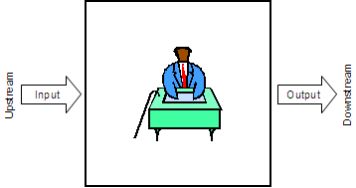
Most of the time, we (IT architects or anyone else) think of our job as a set of tasks that take place in a box. We take inputs from upstream, add some value(hopefully) and create some outputs that we send downstream.

Architecting Out of the Box

It turns out, though (according to Seth), that if we go upstream and alter the stuff that comes to us, it’s a lot easier to do great work. And if we go downstream and teach people how to work with what we created, the final (work) product is better as well.

Seth gives as an example how a medical doctor can consider her work in the box of the examining room. But if she figures out how to get people to quit smoking before they come in, her results are better. If she figures out how to get people to take their pills after they leave, same thing.

As Seth says “the challenge lies in spending a lot of time and money on the upstream and downstream parts of the work, instead of always assuming that your [box] is just what happens inside your cubicle, or as a direct result of your actions”.

So here’s how I would translate this for the humble IT architect:

  • Visit your business sponsors by walking over to their desk (or calling them up on the phone if they happen to be on a different continent). Talk to them. Ask them what is troubling them today and see how you can help.
  • Take a long hard look at those requirements and make a point to go back to the person that wrote them if you don’t understand them. Don’t just assume stuff.
  • One persons architecture is another ones requirements. What you create will be used by designers and coders to build systems from. Make sure they really understand what you want. Go and visit them (possibly virtually) to see what makes them tick.
  • Here’s a really revolutionary idea. Write some code to a) convince youreself you can remember how to do it and b) show your downstream designers/implementers that you know what you are doing and have some empathy.

Most of what we do all day, intentionally or not, is aimed at keeping us in our boxes. Buck the trend and make an effort to get out of that box and make a difference.

Challenging What Architects Do

For most of this year I’ve been fortunate (sic) enough to travel around several countries (and indeed continents) delivering a series of architecture workshops to a client. These workshops aim to teach, through the use of instructor led case studies, best practice approaches to building solution architectures. The workshops take a holistic approach to developing architecture by ensuring both the application as well as infrastructure aspects are considered together and both the functional and non-functional requirements are taken into account.

An enjoyable side-effect of these workshops is I get to meet lots of different people who like to challenge the approach and test my understanding (I sometimes think I’m learning more than the workshop participants). Here’s one such challenge (paraphrased) I received recently: “The problem with architects and the work products they produce (for example models built using the Unified Modeling Language) is that the work products become an end in their own right and we can easily lose track of the fact that actually what we want to build is a system with running code on real hardware”. The clear implications behind this challenge could be described via three architecture anti-patterns:

  • Antipattern: Architecture Overkill. Symptoms: Architects create work that no one understands or cares about. Multiple artefacts with overlapping content get created that no one actually reads. They are too large, too complex and may even be delivered too late.
  • Antipattern: Ivory Tower Architecture. Symptoms: Architects are out of touch with real-world technical aspects. Instead they just sit in their ivory-towers making their pronouncements (which most of the time no one listens to).
  • Antipattern: Work Creation. Symptoms: The role of the architect becomes self-fulfilling. They create work products which only they understand and therefore need more architects to help create these work products.

Here’s my response:

  • Any architectural work product needs to have either an up-stream (e.g. to the business) or down-stream (e.g. to the implementers) justification. Each of these groups of stakeholders needs to be able to recognise how the architecture, as encompassed in the work products, addresses their particular concerns otherwise the work product really is only for its own sake. There are other stakeholders who will have interests or concerns in the architecture but I just focus on these to illustrate my point.
  • The role of the architect needs to be clearly defined and work produced around that role. The role may change as business needs etc evolve but the work created should be in tune with that role and ultimately fulfil the needs of the business. This does not, of course, mean that part of what architects  do is research new technology or try out new ideas. Indeed if they don’t do this the next point will be tricky to fulfil.
  • One of the difficulties with the role of the architect is that it can mean the architect easily becomes out of touch with the latest trends etc in programming. This can be caused by a number of things including: architects are paid too much to do programming, architects are too senior to do programming, architects are too busy to do programming etc. This particular problem is particularly endemic in many services organisations where architects may be charged out at premium rates and where the role of programming is seen as almost too “menial”. What to do? It’s vital that this is not the case. There must always be time allowed in any software architects work day to stay in touch with the stuff that gives him his reason for being.

Enterprise Architecture is Dead. Long Live Interprise Architecture

ZapThink have recently been drip-feeding a series of ZapFlashes predicting the end of Enterprise Architecture (possibly allowing them to derive some further consulting/education business by creating a little fear, uncertainty and doubt). Here are some of their predictions and my thoughts. Comments welcome.

  • The secret to 21st century software innovation. Is, according to ZapThink, in harnessing the power of complex systems (i.e. rather than just enterprise-wide systems). A complex system is one that shows some form of emergent behaviour where the properties of the system as a whole exhibit behaviour that the individual components do not. Most people don’t get this confusing systems that are just complicated with ones that are complex. For me this is spot on. As the enterprise morphs into basically the whole of the internet traditional governance models breakdown. The boundaries of the enterprise can no longer be nicely defined and who is in the enterprise and who is not becomes harder to pin down. People who get this and who can successfully harness the “interprise” (my new word of the month) by using the positive effects of social networking etc will win out over the next few years. Of course this involves huge risks not least of which around how will enterprises keep control of their data and intellectual capital.
  • RIP enterprise software. Enterprise software as provided by the large package providers is seen as large and inflexible and not delivering on the benefits promised by SOA. Companies are finding themselves encumbered with expensive and hard to maintain software they can’t “bend” to do what they want. ZapThink’s take is that whilst enterprise software may have failed SOA has also failed to deliver on its promise of providing flexible business processes that can be quickly adopted to new needs. My take is that like everything else in our industry nothing is given chance to bed in before the next wave comes and sweeps everyone along with it. Many clients I see are still grappling with getting an effective process in place for developing traditional systems let alone service-based ones and definitely cannot deal with complex systems properly.
  • The beginning of the end for Enterprise Architecture frameworks. Architecture frameworks (especially enterprise ones like Zachman and DoDAF) are counterproductive to developing an effective EA strategy. These frameworks are inflexible, sometimes encouraging what ZapThink refer to as checklist architecture. Checklist architecture focuses on achieving goals laid down by the architecture framework rather than the changing needs of the business. True but having no framework at all leads to even greater chaos in my experience. A framework is a structure which is meant to contain relevant guidance and work products to deliver real-world solutions. Frameworks that become too theoretical are always doomed to fail as they should. I hope this forms the basis of something more relevant to the real world.

So how would I characterise “interprise architecture”?

  1. Interprise architecture recognises that it is not enterprise architecture that is dead but trying to constrain architecture by the bounds of the enterprise that is no longer achievable. The ‘architecture’ bit still applies, but not the ‘enterprise’ bit.
  2. Governance models need to recognise that this extended enterprise includes people and other systems that are not controlled by the IT department (people using social networking software who will periodically ‘overlap’ with the enterprises systems).
  3. The ‘architecture’ bit needs to take into account the fact that systems are complex (in the emergent sense of the word) and it’s not always possible to tie down the requirements in a nice orderly way. Indeed fully defining the requirements may be counter-productive and not allow emergent behaviour. Processes for developing such complex systems need to take this into account.

To be sure this is not a complete list. This idea is not yet fully-formed in my own mind and needs a bit more time to ’emerge’ properly. Watch this space as they say.

Social Networking and All That Jazz

I was recently asked what I thought the impact of Web 2.0 and social networking has had or is about to have, on our profession. Here is my take:

  • The current generation of students going through secondary school and university (that will be hitting the employment market over the next few years) have spent most of their formative years using Web 2.0. For these people instant messaging, having huge groups of “friends” and organising events online is as second nature as sending emails and using computers to write documents is to us. How will this change the way we do our jobs and software and services companies do business?
    • Instant and informal networks (via Twitter, Facebook etc) will set up, share information and disappear again. This will allow vendors and customers to work together in new ways and more quickly than ever before.D
    • Devices like advanced smart phones and tablets which can be carried anywhere and are always connected will speed up even more how quickly information gets disseminated and used.
    • Whilst the current generation berates the upcoming one for the time wasted sending pointless messages to friends and creating blog entries hardly anyone reads they at least are doing something different and liberating, creating as opposed to simply consuming content. So what if 99.99% of that content is rubbish? 0.01 or even 0.001 amongst a population of several billion is still a lot of potentially good and innovative thoughts and ideas. The challenge is of course finding the good stuff.
  • Email as an effective communication aid is coming to its natural end. The new generation who have grown up on blogs, Twitter and Facebook will laugh at the amount of time we spend sweating over mountains of email. New tools will need to be available that provide effective ways of quickly and accurately searching the content that is published via Web 2.0 to find the good stuff (and also to detect early potential good stuff).
  • More 20th century content distributors (newspapers, TV companies, book and magazine publishers) will go the way of the music industry if they cannot find a new business model to earn money. This is both an opportunity (we can help them create the new opportunities) and a threat (loss of a large customer base if they go under) to IT professionals and service companies.
  • The upcoming generation will not have loyalties to their employers but only to the network they happen to be a part of at the time. This is the natural progression from outsourcing of labour, destruction of company pension schemes and everyone being treated as freelancers. Whilst this has been hard for the people who have gone through that shift, for the new workers in their late teens and early 20’s they will know nothing else and forge new relationships and ways of working using the new tools at their disposal. Employee turnover and the rate at which people change jobs will increase 10 fold according to some pundits (google ‘Shift Happens’ for some examples).
  • Formal classroom type teaching is essentially dead. New devices with small cameras will allow virtual classrooms to spring up anywhere. Plus the speed with which information changes will mean material will be out of date anyway by the time a formal course is prepared. This coupled with further education institutions having to keep raising fees to support increasing numbers of students will lead to a collapse in the traditional ways of delivering learning.
  • The real value of networks comes from sharing information between as diverse a group of people as possible. Given that companies will be relying less on permanent employees and more on freelancers these networks will increasingly use the internet. This provides some interesting challenges around security of information and managing intellectual capital. The domain of enterprise architecture has therefore just increased exponentially as the enterprise has just become the internet. How will companies manage and govern a network most of which they have no or little control over?
  • The new models for distributing software and services (e.g. application stores, cloud providers) as well as existing ones such as open source will mark the end of the traditional package and product software vendors. Apple overtook Microsoft earlier this year in terms of size as measured by market capitalisation and is now second only to Exxon. Much of this revenue was, I suspect, driven by the innovative ways Apple have devised to create and distribute software (i.e. third parties, sometimes individuals create it and Apple distribute it through their App store).

For two good opposing views on what the internet is doing to our brains read the latest books by Clay Shirky and Nicholas Carr.

Six Non-IT Books for IT Architects

There are now several myriad books out there on the topic of software architecture, including this one I have contributed to. There are other skills an architect needs to do their job which are not just to be found in IT books however. Here are six books which have helped me in my job together with a few reasons why I think they are useful:

  1. Change by Design by Tim Brown. Tim Brown is the CEO of IDEO a design company based in Palo Alto, California. Introduces the concepts of “design thinking” that can be applied to any problem and shows how empathy, play, storytelling and prototyping can all be bought together in coming up with new and innovative designs. Top tip: Deploy interdisciplinary teams of multi-talented people (i.e. true versatilists) to solve hard design problems. Even if you don’t get the book at least visit the link I’ve given to view the wonderful mid map.
  2. Presentation Zen by Garr Reynolds. Garr is the master of giving advice on how to create simple, clear and relevant presentations. Here he applies the zen principles of simplicity that will change how you think about creating presentations using PowerPoint or Keynote. Top tip: Picture superiority effect. Pictures are remembered better than words. Humans are hardwired for using images to communicate. Go visual wherever and whenever you can.
  3. A Whole New Mind by Dan Pink. Dan describe how, if we are to survive in the 21st century world of work, we must make more use of the left side, the creative side, of our brain rather than the traditional right (logical thinking) side. Top tip: Use stories to help illustrate your ideas. Stories represent a pathway to understanding that doesn’t run through the left side of the brain.
  4. Notes on the Synthesis of Form by Christopher Alexander. Alexander recognises that problems come with multiple, poorly understood requirements that interact with each other, creating conflicts and contradictions. Something we in IT have known for years. This book describes an approach for dealing with often multiple conflicting requirements to come up with the “best fit” solution. Top tip: It is difficult to specify a complete set of requirements that need to be met to achieve a “best fit”. A practical approach is to define ‘good fit’ as the absence of ‘misfits’, since these are usually what makes the problem obvious and can be ascertained through inspection of prior designs. Although designers may argue over the importance of a particular misfit, they are less likely to disagree on whether the misfit exists.
  5. Ignore Everybody by Hugh MacLeod. Hugh is an artist that makes a living creating art on the back of business cards, selling wine and running an extremely insightful web site on applying creativity to help you improve your job as well as your life. Top tip: Don’t try to stand out from the crowd, avoid crowds altogether.
  6. The Presentation Secrets of Steve Jobs by Carmine Gallo. Great book with lots of example on how Steve Jobs creates, prepares for and delivers his presentations to introduce new Apple gadgetry on the world. Top tip from book: Use plain English and photographs rather than techno mumbo-jumbo and slides densely packed with indecipherable text and bullet points.

When Systems Fail

This week I was a direct victim of a systems failure that set me thinking about how even mundane activities that we have been doing for several tens, if not hundreds, of years, like checking into a hotel  in this case, rely on systems that we take for granted and which, when they fail, throw everything into complete chaos.It’s a long and not particularly interesting story but in summary I checked into one of the large chain  hotels, which I use a lot, only to find when I opened my room door that the room was in a state of complete chaos and had clearly not been visited by housekeeping that day. On trying to change to another room I was told the system had been down since 4am (it was now 8pm) that morning and the staff could not tell what state rooms were in. Clearly not a great state of affairs and not great for client relations (there were a lot of grumpy people queueing in reception, some of whom I would guess would not be going back to that hotel). So what would an architect of such a system do to mitigate against such a system failure?

  1. I don’t profess to know too much about how hotel management systems work and whether they are provided centrally or locally however I would have thought one of the basic non-functional characteristics of such systems would have been a less than one hour recovery following a system failure (not 16 hours and counting). Learning point: Clarify your availability non-functional requirements (NFRs) and realise them in the relevant parts of the system. Maybe not all components need to be highly available (checking in a customer maybe more important then checking her out for example) but those that are need to be suitable ‘placed’ on high-availability platforms.
  2. There was a clear and apparent need for a disaster recovery plan that involved more than the staff apologising to customers. Learning point: Have a disaster recovery policy and test it regularly.
  3. A system is about more than just the technology; the people that use the system are a part of it as well. Learning point: The architecture of the system should include how the people that use that system interact with it during both normal and abnormal operating conditions.
  4. Often NFRs are not quantified in terms of their business value (or cost). When a problem occurs is the impact to the business (in terms of lost revenue, irate customers who won’t come back etc) really understood? Learning point: Risk associated with not meeting NFRs needs to be quantified so the right amount of engineering can be deployed to address problems that may occur when NFRs are not met.

Formal approaches to handling non-functional requirements in a systems architecture are a little thin on the ground. One approach suggested by the Software Engineering Institute is through the use of architectural tactics. An architectural tactic is a way of satisfying a desired system quality (such as performance) by considering the parameters involved (for example desired execution time), applying one or more standard approaches or patterns (such as scheduling theory or queuing theory) to address potential combinations of parameters and arriving at a reasoned (as opposed to random) architectural decision. Put another way an architectural tactic is a way of putting a bit of “science” behind the sometime arbitrary approach to making architectural decisions around satisfying non-functional requirements.

I think this is a field that is ripe for more work with some practical examples required. Maybe a future hotel management system that adopts such an approach to during its development will allow a smoother check-in process as well.

New Dog, Old Tricks

I can’t believe this but today I have observed no less than three people using the latest wonder-gadget from Apple (the iPad) to play solitaire, Tetris and some other game which seemed to involve nothing more than poking the screen at moving shapes! Having just bought my own iPad and being convinced it conforms to Aurthur C. Clarke’s third law (any sufficiently advanced technology is indistinguishable from magic) I am aghast that such a technological wonder is being used for such mind numbing activities; just dust off your ZX Spectrums guys!

The Three C’s of IT Architects

This is a completely unscientific observation but over the years of being an architect I have observed the following characteristics in people that claim to be members of this profession.  I refer to these as the three C’s of being an IT architect. Some people have only one of these but most have a mix of all three, with maybe one being dominant. The three C’s are: 

  • Creatives – These are the ideas people, that are keen to do new stuff. They are the people that build the solutions that address the business requirements. They have an intimate knowledge of technology (in their particular area of interest or concern) and want to use that technology. If you don’t have these people in your project/team/organisation then nothing will actually get done. The downside of having too much of this attribute is that eventually you have to stop creating and ship something so you need to know when to stop. 
  • Consumers – These are the people that use what the creatives create. Whilst they may not create anything new this type of architect is not without merit. They often combine what others have done in new and innovative ways. We sometimes refer to this activity as reuse, one of the Holy Grails of IT so it is not to be underestimated. If you don’t have these people in your project/team/organisation then chances are the ideas from the creatives will not get fully realised. The downside of having too much of this attribute is that there is a limit to what you can build out of reusing stuff and eventually someone has to come up with some new ideas. 
  • Connectors – These are the people that don’t create or reuse but know people that can do these things and join the two together. Again this is not to be an underestimated skill. After all if a seller cannot find a buyer what’s the point! If you don’t have these people in your project/team/organisation then the two previous types won’t find each other. The downside of having too much of this attribute is that you ain’t going to do anything if all you do is push ideas of others around without creating or reusing things.

From my observations I reckon a ratio of Creatives to Consumers to Connectors needs to be something like 4:2:1.

Incidentally, my guess is that these actually apply to other professions as well but I have even less scientific evidence about those.

10 Things I (Should Have) Learned in (IT) Architecture School

Inspired by this book I discovered in the Tate Modern book shop this week I don’t (yet) have 101 things I can claim I should have learned in IT Architecture School but this would certainly be my 10 things:

  1. The best architectures are full of patterns. This from Grady Booch. Whilst there is an increasing  need to be innovative in the architectures we create we also need to learn from what has gone before. Basing architectures on well-tried and tested patterns is one way of doing this.
  2. Projects that develop IT systems rarely fail for technical reasons. In this report the reasons for IT project failures are cited and practically all of them are because of human (communication) failures rather than real technical challenges. Learning point: effective IT architects need to have soft (people skills) as well as hard (technical skills). See my thoughts on this here.
  3. The best architecture documentation contains multiple viewpoints. There is no single viewpoint that adequately describes an architecture. Canny architects know this and use viewpoint frameworks to organise and categorise these various viewpoints. Here’s a paper myself and some IBM colleagues wrote a while ago describing one such viewpoint framework. You can also find out much more about this in the book I wrote with Peter Eeles last year.
  4. All architecture is design but not all design is architecture. Also from Grady. This is a tricky one and alludes to the thorny issue of “what is architecture” and “what is design”. The point is that the best practice of design (separation of concerns, design by contract, identification of clear component responsibilities etc) is also the practice of good architecture how architectures focus is on the significant elements that drive the overall shape of the system under development. For more on this see here.
  5. A project without a system context diagram is doomed to fail. Quite simply the system context bounds the system (or systems) under development and says what is in scope and what is out. If you don’t do this early you will spend endless hours later on arguing about this. Draw a system context early, get it agreed and print it out at least A2 size and pin it in highly visible places. See here for more discussion on this.
  6. Complex systems may be complicated but complicated systems are not necessarily complex. For more discussion on this topic see my blog entry here.
  7. Use architectural blueprints for building systems but use architectural drawings for communicating about systems. A blueprint is a formal specification of what is to be. This is best created using a formal modeling language such as UML or Archimate. As well as this we also need to be able to communicate our architectures to none or at least semi-literate IT people (often the people who hold the purse). Such communications are better done using drawings, not created using formal modeling tools but done with drawing tools. It’s worth knowing the difference and when to use each.
  8. Make the process fit the project, not the other way around. I’m all for having a ‘proper’ software delivery life-cycle (SDLC) but the first thing I do when deploying one on a project is customise it to my own purposes. In software development as in gentleman’s suits there is no “one size fits all”. Just like you might think you can pick up a suit at Marks and Spencers that perfectly fits you can’t. You also cannot take an off-the-shelf SDLC that perfectly fits your project. Make sure you customise it so it does fit.
  9. Success causes more problems than failure.This comes from Clay Shirky’s new book Cognitive Surplus. See this link at TED for Clay’s presentation on this topic. You should also check this out to see why organisations learn more from failure than success. The point here is that you can analyse a problem to death and not move forward until you think you have covered every base but you will always find some problem or another you didn’t expect. Although you might (initially) have to address more problems by not doing too much up front analysis in the long run you are probably going to be better off. Shipping early and benefitting from real user experience will inevitably mean you have more problems but you will learn more from these than trying to build the ‘perfect’ solution but running the risk of never sipping anything.
  10. Knowing how to present an architecture is as important as knowing how to create one. Although this is last, it’s probably the most important lesson you will learn. Producing good presentations that describe an architecture, that are targeted appropriately at stakeholders, is probably as important as the architecture itself. For more on this see here.
Enhanced by Zemanta

Default Architecture

One of the attributes that many (if not all) complex systems have is the ability to change (customise) them in controlled ways. Indeed this, by definition, is why some systems are complex (that is exhibit  emergent behaviour) because sometimes the users of those systems select options or make choices that enable unexpected behaviour to occur. Giving users such choices clearly has a number of implications on the architecture of a system.

  1. Users have to make a choice, no choice is actually a choice itself as it means they are choosing the default.
  2. Making systems customisable assumes users have the will (and the time) to decide which options they want to change. Many times they don’t so the default becomes very important as it will dictate how the users actually use the system, possibly forever.
  3. The more options that are built into a system the more difficult it becomes to test each potential combination of those options. Indeed there comes a point at which it becomes impossible to test every combination (at least in a reasonable amount of time), hence the importance of beta software (let the users do the testing).

In his blog entry Triumph of the Default Kevin Kelly points out how “the influence of a default is so powerful that one single default can act as a very tiny nudge that can sway extremely large and complex networks”. The oft quoted example of how defaults can influence behaviour is that of organ donation. If you make the donation of organs upon death automatically an “opt out” choice (it happens unless you refuse beforehand) versus “opt in” (it does not happen unless you sign up). A opt out donor system greatly increases the number of organs donated.

For complex systems then, the default architecture of the system becomes very important. The choices the architect makes on behalf of the users of that system will not only dictate how the users will actually use the system but may also influence their behaviour (in both positive and negative ways). Defining the defaults is as important an architectural decision as to what technologies should be used and sufficient time should always be planned in to allow such decisions to be made in a sensible way. The system architecture that results can profoundly affect how that system will be used.