
I would assert that the modern age of commercial computing began roughly 50 years ago with the introduction of the IBM 1401 which was the world’s first fully transistorized computer when it was announced in October of 1959. By the mid-1960’s almost half of all computer systems in the world were 1401 type machines. During the subsequent 50 years we have gone through a number of different ages of computing; each corresponding to the major, underlying architecture which was dominant during each age or period. The ages with their (very) approximate time spans are:
- Age 1: The Mainframe Age (1960 – 1975)
- Age 2: The Mini Computer Age (1975 – 1990)
- Age 3: The Client-Server Age (1990 – 2000)
- Age 4: The Internet Age (2000 – 2010)
- Age 5: The Mobile Age (2010 – 20??)
Of course, the technologies from each age have never completely gone away, they are just not the predominant driving IT force any more (there are still estimated to be some 15,000 mainframe installations world-wide so mainframe programmers are not about to see the end of their careers any time soon). Equally, there other technologies bubbling under the surface running alongside and actually overlapping these major waves. For example networking has evolved from providing the ability to connect a “green screen” to a centralised mainframe, and then mini, to the ability to connect thousands, then millions and now billions of devices. The client-server age and internet age were dependent on cheap and ubiquitous desktop personal computers whilst the current mobile age is driven by offspring’s of the PC, now unshackled from the desktop, which run the same applications (and much, much more) on smaller and smaller devices.
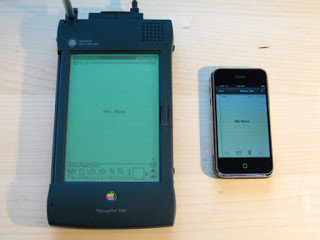
These ages are also characterized by what we might term a decoupling and democratization of the technology. The mainframe age saw the huge and expensive beasts locked away in corporate headquarters and only accessible by qualified members of staff of those companies. Contrast this to the current mobile age where billions of people have devices in their pockets that are many times more powerful than the mainframe computers of the first age of computing and which allow orders of magnitude increases in connectivity and access to information.
Another defining characteristic of each of these ages is the major business uses that the technology was put to. The mainframe age was predominantly centralised systems running companies core business functions that were financially worthwhile to automate or manually complex to administer (payroll, core accounting functions etc). The mobile age is characterised by mobile enterprise application platforms (MEAPs) and apps which are cheap enough to just be used just once and sometimes perform a single or relatively few number of functions.
Given that each of the ages of computing to date has run for 10 – 15 years and the current mobile age is only two years old what predictions are there for how this age might pan out and what should we, as architects, be focusing on and thinking about? As you might expect at this time of year there is no shortage of analyst reports providing all sorts of predictions for the coming year. This joint Appcelerator/IDC Q4 2012 Mobile Developer Report particularly caught my eye as it polled almost 3000 Appcelerator Titanium developers on their thoughts about what is hot in the mobile, social and cloud space. The reason it is important to look at what platforms developers are interested in is, of course, that they can make or break whether those platforms grow and survive over the long term. Microsoft Windows and Apple’s iPhone both took off because developers flocked to those platforms and developed applications for those in preference to competing platforms (anyone remember OS/2?).
As you might expect most developers preferences are to develop for the iOS platforms (iPhone and iPad) closely followed by Android phones and tablets with nearly a third also developing using HTML5 (i.e. cross-platform). Windows phones and tablets are showing some increased interest but Blackberry’s woes would seem to be increasing with a slight drop off in developer interest in those platforms.
Nearly all developers (88.4%) expected that they would be developing for two or more OS’es during 2013. Now that consumers have an increasing number of viable platforms to choose from, the ability to build a mobile app that is available cross-platform is a must for a successful developer.
Understanding mobile platforms and how they integrate with the enterprise is one of the top skills going to be needed over the next few years as the mobile age really takes off. (Consequently it is also going to require employers to work more closely with universities to ensure those skills are obtained).
In many ways the fifth age of computing has actually taken us back several years (pre-internet age) when developers had to support a multitude of operating systems and computer platforms. As a result many MEAP providers are investing in cross platform development tools, such as IBM’s Worklight which is also part of the IBM Mobile Foundation. This platform also adds intelligent end point management (that addresses the issues of security, complexity and BYOD policies) together with an integration framework that enables companies to rapidly connect their hybrid world of public clouds, private clouds, and on-premise applications.
For now then, at least until a true multi-platform technology such as HTML5 is mature enough, we are in a complex world with lots of new and rapidly changing technologies to get to grips with as well as needing to understand how the new stuff integrates with all the old legacy stuff (again). In other words, a world which we as architects know and love and thrive in. Here’s to a complex 2013!
 Software Architecture Zen