Evolutionary Systems Development Process

As I’m now into my second year I reckon I can become more experimental in my blogs. This entry is therefore completely off the scale and will either not go any further or be the start of something much bigger. Comments suggesting which it is are welcome.If we want to be able to build real complex systems (see previous entry for what these are) what might we do differently to ensure we allow truly emergent properties to appear? Is there a development process that we could adopt that both ensured something was delivered in a timely fashion but that also allowed sufficient ‘flex’ such that emergent behaviour was not prevented from happening? In other words is it possible to allow systems to evolve in a managed way where those properties that we value are allowed to grow and thrive but those that are of no use can be prevented from appearing or stopped early on?

Here are some properties I think any such a development process (an evolutionary systems development process) should have if we are to build truly complex systems

  1. The process needs to be independent of any project. Normally we use processes to derive some kind of work breakdown structure which is used to plan the project that will deliver the system. In other words there is a well defined start and end point with clear steps stating who does what by when in between. However for a complex system there is by definition no stopping point; just a number of evolutions where each introduces new (and possible unpredictable) behaviour.
  2. The process should be driven not so much by what users want but by what users do. Most processes start with a list of requirements, possibly expressed as use cases, which describe scenarios for how the system will be used. The problem with this approach is that use cases only describe what a user can envisage doing with the system and will not capture what they actually end up doing with the system. In other words the system is deemed to be ‘complete’ once all the use cases have been realised. However what if the act of delivering the system itself results in new use cases emerging. Ones that were not planned for? How do they get realised?
  3. The process must be both flexible enough to allow users to experiment and envisage doing new things whilst at the same time being robust enough not to allow negative emergent behaviour that will prevent any system being delivered or lead to the system deteriorating over time.
  4. If new behaviour is to be adopted this must be of overall benefit to the majority and must still meet (a possibly changed) set of business objectives. The process must therefore allow for some kind of voting system where the majorities behaviour is allowed to dominate. The trick is not allow new and innovative behaviour to be crushed early on.
  5. The underlying rules that control how the systems responds to external stimuli must themselves be easily adaptable. The process must therefore treat as peers the rules that govern (allowable) behaviour together with the description of the behaviour itself. Rules set some kind of constraint on what is allowable and not allowable by the system.

Of course not all systems that we build will or should be complex ones. As noted previously safety-critical systems need to behave in entirely predictable ways and users should not be allowed to change the behaviour of these where lives could be put at risk. So what type of systems might benefit from an evolutionary approach to development?

  1. Social networking systems where the users are intimately bound up with the system itself.
  2. Commerce systems where the buying behaviour of users might change how and when certain products are sold and at what price.
  3. Financial systems where money markets may affect what users do and how they respond.
  4. Government systems where responses to new legislation or the behaviour of citizens needs fast responses.
  5. Other, you decide?

My next step is to think about what the elements (process phases, work products etc) of an evolutionary systems development process might be.

Complex Systems versus Complicated Systems

Brian Kernighan,co-author of the C programming language, once said:

Controlling complexity is the essence of computer programming.

We live in a world where the systems that we use or come across in our day to day lives seem to be ever more complicated. The flight software system that controls a modern aircraft like the new Boeing 787 “Dreamliner” are, on the face of it at least, almost unimaginatively complicated, simply because of their sheer size. According to NASA the software that runs the 787 is almost seven million lines of Ada code, triple that of the 777. The F35 Joint Strike Fighter has 19 million lines of C and C++ code! Does all this mean that these systems are also complex however and if not what’s the difference? Inevitably there are a large number of definitions of exactly what a complex system is however they all seem to agree on a few common things:

  1. They are made up of a collection of components.
  2. The components interact with each other.
  3. These interactions can result in emergent behavior.

Emergent behavior refers to the property that a collection of simple components may exhibit when the interactions between them result in new, and sometimes unpredictable, behavior that none of the components exhibit individually. So whilst complicated systems may be complex (and exhibit emergent properties) it does not follow that complex systems have to be complicated. In fact relatively simple systems may exhibit emergent properties.

In his book Emergence Steven Johnson gives several examples of the emergent properties of all sorts of systems from colonies of ants through to software systems. Whilst some software systems clearly thrive on being complex systems where emergent behavior is a positive benefit (I’m thinking Facebook, World of Warcraft and SecondLife for example) we might be a bit more dubious about getting on an aircraft whose flight software system exhibits emergent behavior! My guess is that most of us would prefer it if that software showed entirely predictable behavior.

Here’s the thing however. Should it not be possible to build some of our business systems where emergent behavior could be allowed and for the systems themselves to be self adjusting to take advantage of that behavior? How might we do that and what software delivery lifecycles (SDLC) might we adopt to allow that to happen? The interesting thing about SDLCs of course is that almost by definition they build predictability into the systems that are developed. We want those systems to behave in the way the users want (i.e. we want them to “meet the requirements”), not in unpredictable ways. However the thing about systems like Facebook is that the users are an integral part of that system and they drive its behavior in new and interesting ways. The developers of Facebook are able to observe this and respond to new ways in which their system is being used, adapting it accordingly. Facebook has clearly been architected in a way that allows this to happen (Nice one Zuck). The problem with many of our business systems is that they are too rigid and inflexible and do not allow emergent behavior. Even the promise of Service Oriented Architecture (SOA) where we were supposed to be able to reconfigure our business processes almost at will by combining services together in new and interesting ways has not really delivered on that promise. I think that this is for two reasons:

  1. We have failed to adapt our (SDLC) processes to take into account that property and are instead building the same old rigid systems out of slightly new sets of moveable parts.
  2. We fail to recognise that the best complex systems have people in them as an integral part of their makeup and that it is often the combination of people and technology that drive new ways of using systems and therefore emergent properties.

Building and managing complex systems needs to recognise the fact that the same old processes (SOPs) may no longer work and what new processes we new develop need to better account for people being an integral part of the system as it is used and evolves. The potential for emergent behavior needs not only to be allowed for but to be positively encouraged in certain types of system.


Tweets, Cocktail Parties and the Real-Deal

You can have the greatest idea in the world but if you can’t present it effectively, aiming it at the interest level and time your audience has, then it’s not going to fly. Here’s a three-pronged approach to getting your ideas across I have borrowed from Dan Pink’s book Drive: The Surprising Truth About What Motivates Us (if you want a quick, animated summary of the book check this out).

You need to be prepared at all times to explain your idea. The amount of time you have to explain it will depend on a number of factors, not least of which is the amount of ‘face-time’ your stakeholder will give you. Here are three formats you should have prepared for selling your idea depending on how much time you can get:

  1. The Tweet version: A tweet (as delivered via twitter) can be a maximum of 140 characters. The challenge is can you describe your idea in 140 characters or less. Samuel Johnson (or Mark Twain or Winston Churchill depending on who you believe) said “I did not have time to write you a short letter, so I wrote you a long one instead”. This version is the most challenging of all. You really need to be brutal and pare your idea down to just the key facts.
  2. The Cocktail Party version: This is a variant on the elevator pitch. Can you describe you idea in 100 – 150 words or a maximum of one minute of talking (talking fast doesn’t count). Again you need to focus on the bare essentials but here you have a bit more leeway to focus on the business benefits.
  3. The Real-Deal version (with supporting takeaway): So you twittered your idea, you met some guy at a cocktail party (or in the elevator) to entice him a bit more and you finally got invited to present your idea. The presentation is the real-deal because this is really your chance to stand up and sell (and hopefully clinch the deal). Don’t, therefore, screw-up by preparing an overly busy presentation with slides full of tightly packed text (remember PowerPoint bullets kill interest like real bullets kill people). Suppose you have “an hour” to present. Aim for a presentation that can be done in 30 minutes allowing for 15 minutes of questions and five minutes or so either side for people to be late or have to leave early. No one can retain an interest for more than 50 minutes anyway so 30 is good. For some thoughts on presenting see here. I prefer not to follow rules like “one slide every two minutes”. The important thing is to structure the presentation first (probably before opening up your favourite presentation software) then write it, then practice until it fits into 30 minutes. For an interesting alternative view on how big a presentation should be see here (a slide every 12 seconds maybe!). Finally, because you will inevitably have had to leave out some detail prepare a short (two to four pages) takeaway which explains your idea that you can leave behind for your audience to take-away. Make sure you include the tweet as the “management summary”. You never know, your stakeholder may tweet it herself giving you a bit more publicity!

It’s Easy to Spot a Purist…

…they’re the ones with no skin in the game. I came across this whilst reading about Hugh MacLeod’s new book on his blog. It set me thinking about how true this can sometimes be from an architecture perspective. Steve Jobs famously said “real artists ship”. Whilst there is a point to building good architectural models, defining principles that should be followed and road maps that describe the directions architects will be travelling in there comes a point that we must say “enough is enough, it’s time to ship”. The fact of the matter is that software development is, and always will be, a complicated activity and there is often no clearly defined answer to the wicked problems we need our systems to address. In fact, two of the attributes of a wicked problem namely, wicked problems have no stopping rule (instead the problem solving process ends when you run out of resources rather than when some ‘correct’ solution emerges) and solutions to wicked problems are not right or wrong (they are simply better, worse, good enough or not good enough) would seem to encourage the kind of purist behaviour where nothing ever ships. The danger with architecture (especially Enterprise Architecture) is that the artefacts being created are intangible things like models, road maps and principles and these by themselves do not make working systems. The people that produce such artefacts could often be accused of having “no skin in the game”. So how should you ensure that the architects in your organisation do indeed have skin in the game and knows that shipping is actually all that matters? Here is my SKIN (Specify Kill Integrate Negate) rule of thumb for ensuring delivery takes protracted (and unnecessary) analysis.

  • Specify to the right level of abstraction and detail, no more no less. The models, road maps, architectural principles that are defined by architects should be understood and usable by as many stakeholders as possible. This may mean having different views (levels of abstraction) of the same model but ensure if this is the case, those views are consistent. Think who your stakeholder is meant to be before building the artefacts and don’t build it if you can’t explain it clearly to that stakeholder.
  • Kill unwanted artefacts. Sometimes with the best will in the world you will build an artefact that does not have a purpose, is not read by anyone or has expired. Kill it, don’t let it linger on causing confusion and giving you an unnecessary maintenance overhead. Look at something like TOGAF for a good set of useful artefacts.
  • Integrate the work of the architect(s) with real downstream activities. Don’t let them work in ivory towers which have no grounding in reality. When planning a project and considering what artefacts need to be planned it is useful to think of what the inputs are to the task that is to create the artefact. If you cannot see any of the artefacts that are output from architecture tasks being used than maybe it’s time to consider killing off those artefacts (see above).
  • Negate unnecessary activities and tasks. Every task should have an output. This is usually in the form of a work product (a model, a piece of code, a plan or whatever). If you find you have some architecture tasks or activities (groups of relates tasks) that are not producing useful artefacts then its probably time stop performing those tasks.

Gapology

gap·ol·o·gy n. The systematic study of, and the method used to identify and close, gaps within and between organisational units (individuals, teams, departments) or social structures (gender gaps, race gaps). Becoming an expert in using gapology or studying gapology are the behaviors of a gapologist.

Okay, this is a definition I made up to make a point and create a reason for this post! You’ll find a couple more definitions here. My observation is that many of the problems we face in systems development are due to the presence of gaps of various sorts. Until we fill such gaps we will not be able to build systems that are as effective or efficient as they might be. Here are some of the worst.

  • The Knowing-Doing Gap. An article in Fast Company discusses this book which asks: Why is it that, at the end of so many books and seminars, leaders report being enlightened and wiser, but not much happens in their organizations?
  • The Business-IT Gap. The best known gap in IT. This is the inability IT have in understanding what business people really want (or the inability the business have in saying what it is they want depending on which side of the gap you are sitting).
  • The IT-IT Gap. This is the gap between what IT develops and what operations/maintenance think they are getting and need to run/maintain.
  • The Gender Gap. As I’ve discussed here there is still unfortunately a real problem getting women into IT which I think is detrimental to the systems we build.

Many of these gaps occur because of the lack of effective stakeholder management that takes place when building systems. A report published back in 2004 (The Challenges of Complex IT Projects) by The Royal Academy of Engineering and and The British Computer Society identified the lack of effective stakeholder management as one of the key reasons for project failure. The key learning point I believe is to understand who your stakeholders are, engage with them early and often and make sure you have good communication plans in place that keep them well informed.

On Thinking Architecturally

Tim Brown (CEO of IDEO) has written a great book on design thinking called Change by Design. Check out the link to see his mind-map of what the book is about.The basic premise of the book, why its about design thinking rather just design, is that design thinkers take a far more holistic approach to solving design problems. They use an interdisciplinary approach, think around the problem, including viewing the constraints as enablers rather than what should be fought against, and come up with ideas that would otherwise not have been thought of if ‘ordinary’ design had been applied. One of the case studies Tim uses in the book is the setting up of a live laboratory in the Mayo Clinic in Rochester, Minnesota to develop new approaches to patient care which involved designers, health care professionals, business strategists and patients to develop ideas for the “patient-provider experience”. A methodology called SPARC (See-Plan-Refine-Communicate) was adopted (which is I suspect based on the Deming Cycle) to show how design thinking could be applied not only to product design but also service design.

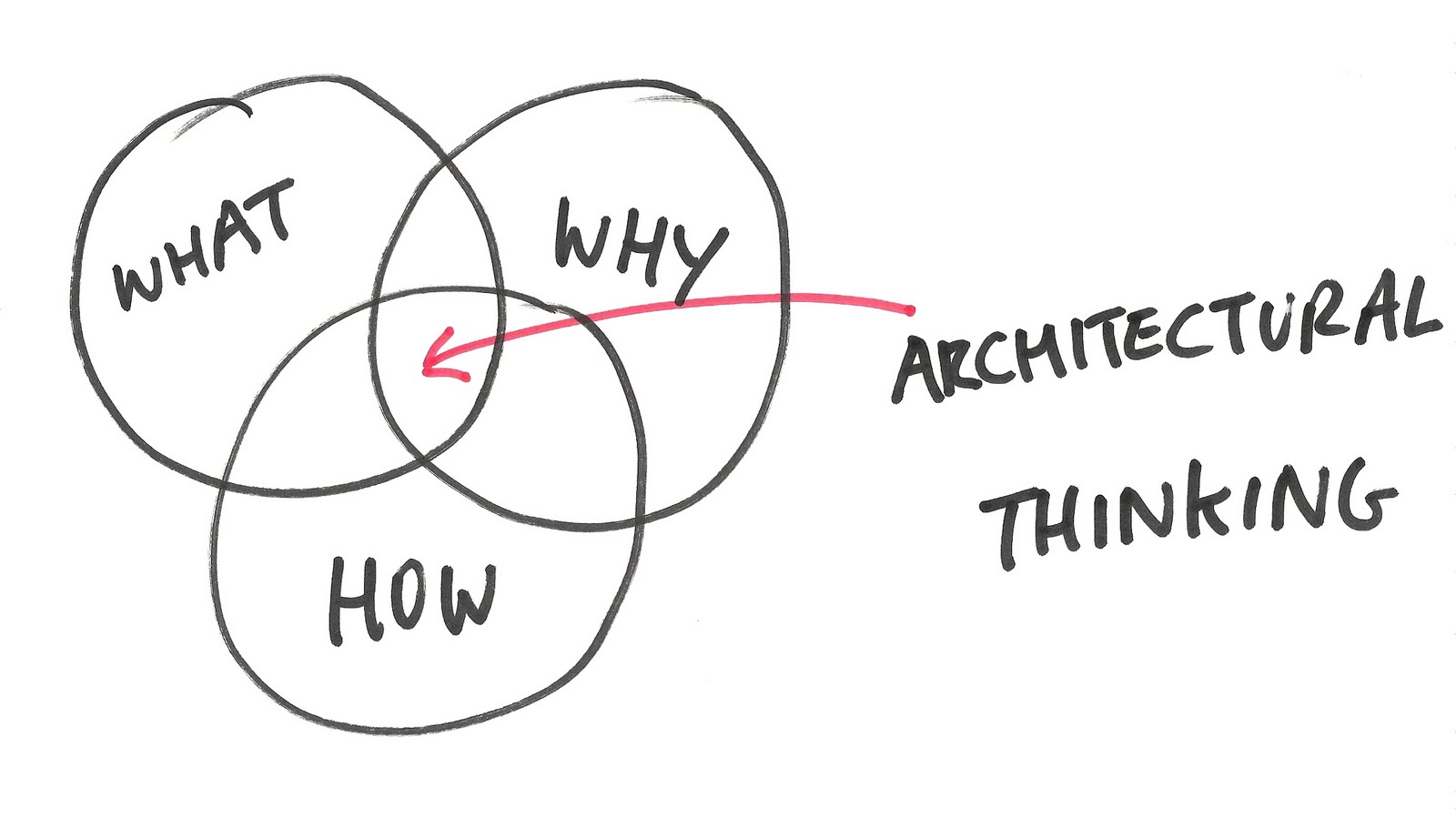
Returning to the mind-map that is on the inside front-cover of Change by Design its two starting points are ‘What’ (is it we are trying to do/solve) and ‘How’ (are we going to approach the design). This fits nicely with my own concept of what we term ‘architectural thinking‘ where we add an additional ‘node’ which is ‘Why’ (are we doing it this way). I prefer to illustrate this as a Venn diagram as shown below. The intersection of the three sets is what we consider when ‘thinking architecturally’.

  • What – The requirements we are trying to address. Architectural thinking focuses is on those requirements (functional, qualities and constraints) we think are architecturally significant in some way.
  • Why – Captures the key decisions we are making. Architectural thinking focuses on the architectural aspects which lead to major structuring, placement or procurement decisions. Could be explicit (as a fully documented decision with options looked at and rational for making the decision we did) or implicit in a diagram or model.
  • How – The design and implementation of the system. Architectural thinking focuses on those elements of the design that are significant to the architecture (maybe patterns applied, key principles adopted etc).

The key thing in all this is that the thinking applies to the significant elements not everything. The key skill of the architect is to understand which things are important and which can be left to someone else to fret over.

We Need More Women (IT) Architectural Thinkers (Duh)!

Yes I know, a statement of the blindingly obvious. People of have been bleating on about this for years but nothing much seems to change. My recent and current experiences of teaching IT architecture for a number of different clients rarely has more than 10% of the classes being made up of women (and its usually 0%!). Even more depressingly, from what I’ve seen of university IT courses, there seems to be a similarly small number of female students entering into careers in IT. So why does it matter that 50% of the worlds population only have such a poor showing in this profession?

In his book Change by Design Tim Brown, CEO and president of IDEO relates the following apocryphal story. Whilst working on a kid’s product for Nike IDEO gathered a group of kids at their Palo Alto design studio to brainstorm ideas. The boys and girls (who were eight to ten year olds) were split into separate groups in different rooms, given some instructions and left to get on with it for an hour. When the results were analysed it was found that the girls had come up with more than two hundred ideas whereas the boys had struggled to come up with fifty. The reason for this? The boys were eager to get their ideas out there and were barely conscious of of the ideas of their fellow brainstormers. The girls on the other hand “conducted a spirited but nonetheless serial conversation in which each idea related to the one that had come before and became a springboard to the one that came next”. According to Tim one of the key rules of brainstorming is to “build on the ideas of others” and it would seem girls have an innate ability to do this whereas boys, possibly due to their more competitive tendencies, want to force the ideas to be the ones that “win”.

Although this story relates to a group of eight to ten year olds my own anecdotal evidence indicates it is equally applicable to all age groups. When observing how team members interact on case studies that we run as part of our architecture classes there is inevitably better and more informed discussion and end results when the teams are mixed (even when females are in the minority) than when they are made up of all males.

My hope is that we are entering a new age of enlightenment when it comes to how we put together project teams that are made up of true versatilists rather than traditional teams of “hard-core” IT techie types. Versatilists by definition have good skills across a range of disciplines whether it be in the arts, humanities or sciences. It is, I believe, only in bringing together both this range of disciplines together with mixed genders that we can hope to address some of life’s harder problems. Problems that not only require new ideas but solutions that build on the ideas of others rather than re-inventing everything from scratch in the usual brute force, testosterone charged way we typically seem to approach problem solving in IT.