On Thinking Architecturally

Tim Brown (CEO of IDEO) has written a great book on design thinking called Change by Design. Check out the link to see his mind-map of what the book is about.The basic premise of the book, why its about design thinking rather just design, is that design thinkers take a far more holistic approach to solving design problems. They use an interdisciplinary approach, think around the problem, including viewing the constraints as enablers rather than what should be fought against, and come up with ideas that would otherwise not have been thought of if ‘ordinary’ design had been applied. One of the case studies Tim uses in the book is the setting up of a live laboratory in the Mayo Clinic in Rochester, Minnesota to develop new approaches to patient care which involved designers, health care professionals, business strategists and patients to develop ideas for the “patient-provider experience”. A methodology called SPARC (See-Plan-Refine-Communicate) was adopted (which is I suspect based on the Deming Cycle) to show how design thinking could be applied not only to product design but also service design.

Returning to the mind-map that is on the inside front-cover of Change by Design its two starting points are ‘What’ (is it we are trying to do/solve) and ‘How’ (are we going to approach the design). This fits nicely with my own concept of what we term ‘architectural thinking‘ where we add an additional ‘node’ which is ‘Why’ (are we doing it this way). I prefer to illustrate this as a Venn diagram as shown below. The intersection of the three sets is what we consider when ‘thinking architecturally’.
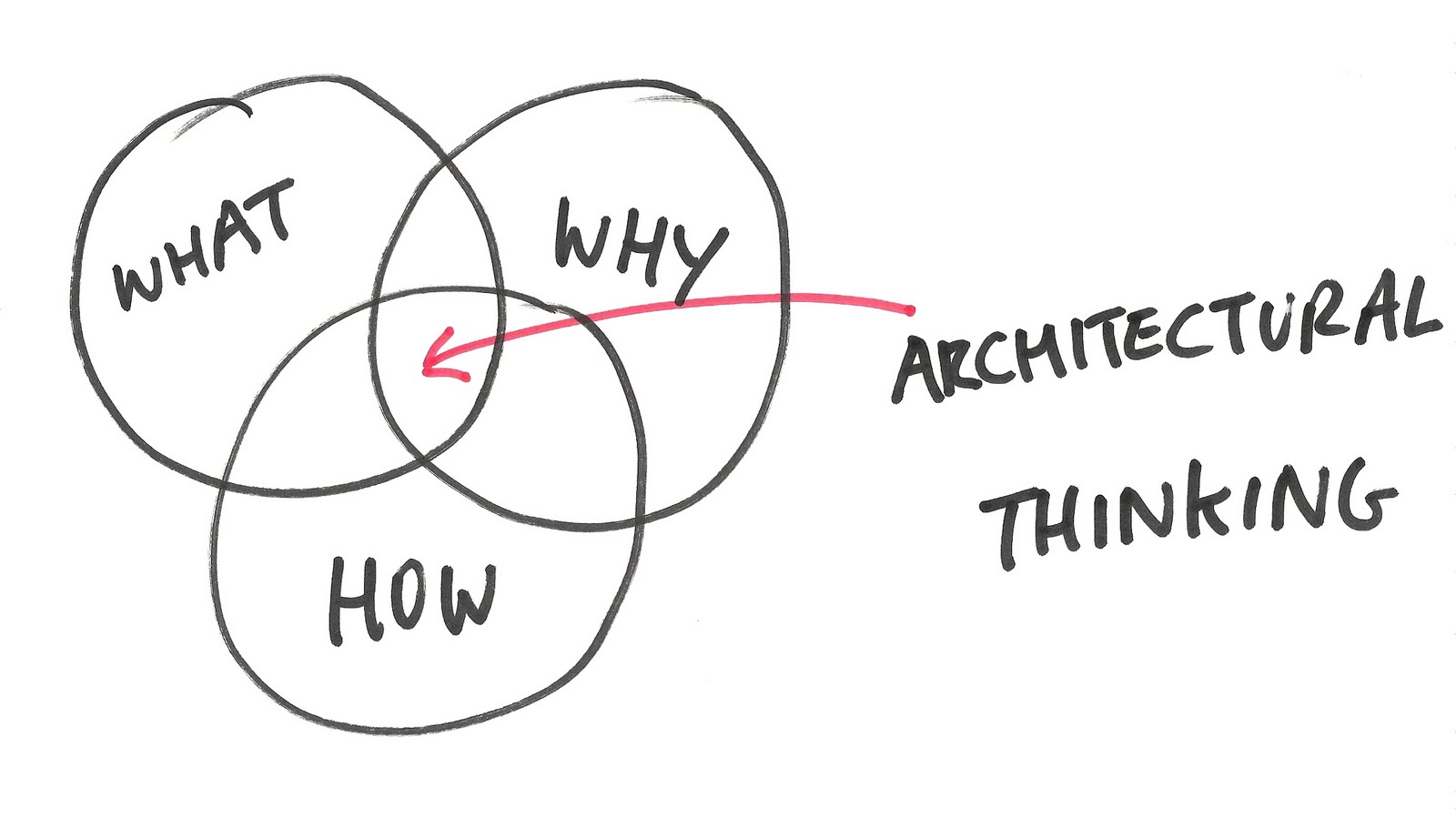
  • What – The requirements we are trying to address. Architectural thinking focuses is on those requirements (functional, qualities and constraints) we think are architecturally significant in some way.
  • Why – Captures the key decisions we are making. Architectural thinking focuses on the architectural aspects which lead to major structuring, placement or procurement decisions. Could be explicit (as a fully documented decision with options looked at and rational for making the decision we did) or implicit in a diagram or model.
  • How – The design and implementation of the system. Architectural thinking focuses on those elements of the design that are significant to the architecture (maybe patterns applied, key principles adopted etc).

The key thing in all this is that the thinking applies to the significant elements not everything. The key skill of the architect is to understand which things are important and which can be left to someone else to fret over.

We Need More Women (IT) Architectural Thinkers (Duh)!

Yes I know, a statement of the blindingly obvious. People of have been bleating on about this for years but nothing much seems to change. My recent and current experiences of teaching IT architecture for a number of different clients rarely has more than 10% of the classes being made up of women (and its usually 0%!). Even more depressingly, from what I’ve seen of university IT courses, there seems to be a similarly small number of female students entering into careers in IT. So why does it matter that 50% of the worlds population only have such a poor showing in this profession?

In his book Change by Design Tim Brown, CEO and president of IDEO relates the following apocryphal story. Whilst working on a kid’s product for Nike IDEO gathered a group of kids at their Palo Alto design studio to brainstorm ideas. The boys and girls (who were eight to ten year olds) were split into separate groups in different rooms, given some instructions and left to get on with it for an hour. When the results were analysed it was found that the girls had come up with more than two hundred ideas whereas the boys had struggled to come up with fifty. The reason for this? The boys were eager to get their ideas out there and were barely conscious of of the ideas of their fellow brainstormers. The girls on the other hand “conducted a spirited but nonetheless serial conversation in which each idea related to the one that had come before and became a springboard to the one that came next”. According to Tim one of the key rules of brainstorming is to “build on the ideas of others” and it would seem girls have an innate ability to do this whereas boys, possibly due to their more competitive tendencies, want to force the ideas to be the ones that “win”.

Although this story relates to a group of eight to ten year olds my own anecdotal evidence indicates it is equally applicable to all age groups. When observing how team members interact on case studies that we run as part of our architecture classes there is inevitably better and more informed discussion and end results when the teams are mixed (even when females are in the minority) than when they are made up of all males.

My hope is that we are entering a new age of enlightenment when it comes to how we put together project teams that are made up of true versatilists rather than traditional teams of “hard-core” IT techie types. Versatilists by definition have good skills across a range of disciplines whether it be in the arts, humanities or sciences. It is, I believe, only in bringing together both this range of disciplines together with mixed genders that we can hope to address some of life’s harder problems. Problems that not only require new ideas but solutions that build on the ideas of others rather than re-inventing everything from scratch in the usual brute force, testosterone charged way we typically seem to approach problem solving in IT.

Design Really Does Matter

I’ve just received a new work laptop and what a monstrosity it is! There was a time when ThinkPads were actually quite sexy as far as laptops go but this model (a T400 if you’re interested) is a complete abomination of a thing. It’s not only square and clunky feeling but for some mysterious reason the designers have made the battery stick out of the back like some large cancerous growth. Why, if Apple can design a laptop with a supposed 6 hour battery life where the battery is hidden completely inside the case do Lenovo designers have to create something that has the battery hanging out the back and appear to offer no more life?

What’s all this got do do with the zen of architecture you might ask? I’ve been reading the latest book by Garr Reynolds, Presentationzen Design where Garr suggests we should take inspiration for good design from the products we see around us all day. The ThinkPad would seem to be a good design antipattern to me. Of course, as Hugh MacLeod says “there’s no correlation between creativity and equipment ownership” and “a fancy tool just gives a second-rater one more pillar to hide behind.” That said, I feel sure that using a tool that is both good to look and is well designed makes for an all round better experience that must aid in the flow of the creative juices. If you don’t have the ideas in the first place then the best tool in the world won’t help you create them but if you do have something to say what would you rather write with, the free pen from the hotel room or the Mont Blanc you got for Christmas?