Software Developments Best Kept Secret

A few people have asked what I meant in my previous entry when a said we should be “killing off the endless debates of agile versus waterfall.” Don’t get me wrong, I’m a big fan of doing development in as efficient a way as possible, after all why would you want to be doing things in a ‘non-agile’ way! However I think that the agile versus waterfall debate really does miss the point. If you have ever worked on anything but the most trivial of software development projects you will quickly realise that there is no such thing as a ‘one size fits all’ software delivery lifecycle (SDLC) process. Each project is different and each brings its own challenges in terms of the best way to specify, develop, deliver and run it. Which brings me to the topic of this entry, the snappily titled Software and Systems Process Engineering Metamodel or ‘SPEM’ (but not SSPEM).

SPEM is a standard owned by the Object Management Group (OMG), the body that also owns the Unified Modeling Language (UML), the Systems Modeling Language (SysML) and a number of other open standards. Essentially SPEM gives you the language (the metamodel) for defining software and system processes in a consistent and repeatable way. SPEM also allows vendors to build tools that automate the way processes are defined and delivered. Just like vendors have built system and software modeling tools based around UML so too can vendors build delivery process modeling tools built around SPEM.

So what exactly does SPEM define and why should you be interested in it? For me there are two reasons why you should look at adopting SPEM on your next project.

  1. SPEM separates out what you create (i.e. the content) from how you create it (i.e. the process) whilst at the same time providing instructions for how to do these two things (i.e. guidance).
  2. SPEM (or at least tools that implement SPEM) allows you to create a customised process by varying what you create and when you create it.

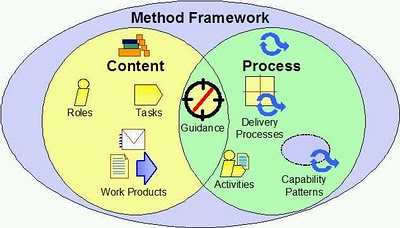
Here’s a diagram to explain the first of these.
SPEM Method Framework
The SPEM Method Framework represents a consistent and repeatable approach to accomplishing a set of objectives based on a collection of well-defined techniques and best practices. The framework consists of three parts:
  • Content: represents the primary reusable building blocks of the method that exist outside of any predefined lifecycle. These are the work products that are created as a result of roles performing tasks.
  • Process: assembles method content into a sequence or workflow (represented by a work breakdown structure) used to organise the project and develop a solution. Process includes the phases that make up an end-to-end SDLC, the activities that phases are broken down into as well as reusable chunks of process referred to as ‘capability patterns’.
  • Guidance: is the ‘glue’ which supports content development and process execution. It describes techniques and best-practice for developing content or ‘executing’ a process.

As well as giving us the ‘language’ for building our own processes SPEM also defines the rules for building those processes. For example phases consist of other phases or activities, activities group tasks, tasks take work products as input and output other work products and so on.

This is all well and good you might say but I don’t want to have to laboriously build a whole process every time I want to run a project. This is where the second advantage of using SPEM comes in. A number of vendors (IBM and Sparx to name two) have built tools that not only automate the process for building a process but which also contain one or more ‘ready-rolled’ processes to get you started. You can either use those ‘out of the box’, extend them by adding your own content or start from scratch (not recommended for novices). What’s more the Eclipse foundation have developed an open software tool, called the Eclipse Process Framework (EPF) that not only gives you a tool for building processes but also comes with a number of existing processes, including OpenUP (open version of the Rational Unified Process) as well as Scrum and DSDM.

If you download and install EPF together with the appropriate method libraries you can use these as the basis for creating your own processes. Here’s what EPF looks like when you open the OpenUP SDLC.

EPF and OpenUP

The above view shows the browsing perspective of EPF, however there is also an authoring perspective which allows you to not only reconfigure a process to suit your own project but also add and remove content (i.e. roles, tasks and work products). Once you have made your changes you can republish the new process (as HTML) and anyone with a browser can then view the process together with all of it work products and, most crucially, associated guidance (i.e. examples, templates, guidelines etc) that allow you to use the process in an effective way.

This is, I believe, the true power of using a tool like EPF (or IBM’s Rational Method Composer which comes preloaded with the Rational Unified Process). You can take an existing SDLC (one you have created or one you have obtained from elsewhere) and customise it to meet the needs of your project. The amount of agility and number of iterations etc that you want to run will depend on the intricacies of your project and not what some method guru tells you that you should be using!

By the way for an excellent introduction and overview of EPF see here and here. The Eclipse web site also contains a wealth of information on EPF. You can also download the complete SPEM 2 specification from the OMG web site here.

Architecture Drill Down in the UML

Solution Architects need to create models of the systems they are building for a number of reasons:

  • Models help to visualise the component parts, their relationships and how they will interact.
  • Models help stakeholders understand how the system will work.
  • Models, defined at the right level of detail, enable the implementers of the system to build the component parts in relative isolation provided the interfaces between the parts are well defined.

These models need to show different amounts of detail depending on who is looking at them and what sort of information you expect to get from them. Grady Booch says that “a good model excludes those elements that are not relevant to the given level of abstraction”. Every system can be described using different views and different models. Each model should be “a semantically closed abstraction of the system” (that is complete at what ever level it is drawn). Ideally models will be both structural, emphasizing the organization of the system, as well as behavioral, emphasizing the dynamics aspects of the system.

To support different views and allow models to be created at different levels of abstraction I use a number of different diagrams, created using the Unified Modeling Language (UML) in an appropriate modeling tool (e.g. Rational Software Architect or Sparx Enterprise Architect). Using a process of “architecture drill-down” I can get both high level views as well as detailed views that are relevant to the level of abstraction I want to see. Here are the views and UML diagrams I create.

  • Enterprise View (created with a UML Package diagram). This sets the context of the whole enterprise and shows actors (users and other external systems) who interact with the enterprise.
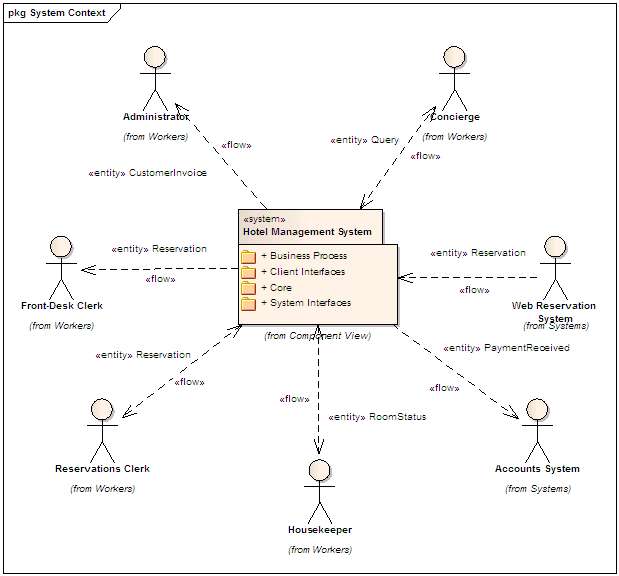
  • System View (Package diagram). This shows the context of an individual system within the enterprise and shows internal workers and other internal systems.
  • Subsystem View (Package diagram). This shows the breakdown of one of the internal systems into subsystems and the dependencies between them.
  • Component View (Component diagrams and Sequence diagrams). This shows the relationships between components within the subsystems, both static dependency type relationships (through the UML Component diagram) as well as interactions between components (through the UML Sequence diagram).
  • Component Composition View (Composite Structure diagram). This shows the internal structure of a component and the interfaces it provides.

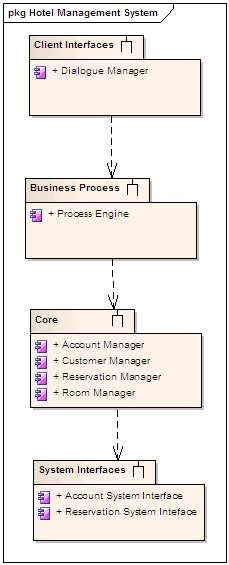
Note hat a good tool will link all these together and ideally allow them to be published as HTML allowing people without the tool to use them and also navigate through the different levels. Illustrative examples of the first three of the diagrams mentioned above are shown below. These give increasing levels of detail for a hypothetical hotel system. Click on the picture to get a bigger view.

Enterprise View
System View
Subsystem View

In the actual tool, Sparx Enterprise Architect in this case, each of these diagrams is linked so when I click on the package of the first it opens up the second and son on. When published as HTML this “drill-down” gets maintained as hyperlinks allowing for easy navigation and review of the architecture.

Skills for Building a Smarter Planet: A Manifesto

IBM is currently doing a big advertising campaign called Smarter Planet. I recently put together a lecture for a group of university students which tried to weave together a number of themes which I am currently interested in:

Here’s my manifesto:

In the 21st century IT professionals must adopt more of a systems thinking approach if they are to solve the wicked problems the world faces. If we are truly going to build a smarter planet then we need a new breed of versatilists who are able to solve these problems.

There are a number of themes here I plan to return to in future posts.

Does Architecture Matter Any More?

I’ve been reading up on the whole cloud/mashups/social computing thing and the above question occurred to me. Within the context of what are essentially several new architectural styles what is the role of the architect in all of this and what exactly is the architecture he or she is trying to create? In attempting to answer this question my mind diverted to an IT architecture course that I have been lucky enough to teach on a number of occasions both inside and outside IBM. The course is called Architectural Thinking. I imagine (hope) that some people reading this will have attended that class and it occurred to me just how clever the people that created the first version of that class back in 1999 were. The key word of course is thinking. It’s not a class about a particular style of architecture, about a particular architectural process and is certainly (thankfully) not about any particular technology. The key part of that class is about how to think about problems and create architectures, often using an existing style or pattern, to come up with solutions to a client’s business problem. The main axiom being that the architecture should drive the technology and not the other way round. In other words it’s about the fundamentals that never go out of style or, to paraphrase Grady Booch:

Architectural styles come and go but the enduring fundamentals (crisp abstractions; clear separation of concerns; balanced distribution of responsibilities; simplicity) endure and never go out of style.

This course is available outside of IBM for clients so if anyone is interested in running the class get in touch with me on here.

Wot No Blogging?

I think I’ve only just realised how much of a commitment keeping a “proper” blog (that is one that doesn’t just regurgitate information discovered elsewhere without adding some additional value or, better still, creating brand new content) takes! I’ve been distracted by other things of late (anyone looking at where I currently work and who is aware of what is happening in the UK economy at present may be able to guess what) however this month I intend to return with, I hope, a vengeance and give myself the target of blogging at least two meaningful, and hopefully of value, entries each month. This one does not count by the way.