Making Smart Architecture Decisions

Seth Godin whose blog can be found here, posted a wonderful entry called The extraordinary software development manager yesterday which contains some great axioms for managing complex software projects, the last of which is something I wish I’d written! Here is what it says:

Programming at scale is more like building a skyscraper than putting together a dinner party. Architecture in the acquisition of infrastructure and tools is one of the highest leverage pieces of work a tech company can do. Smart architecture decisions will save  hundreds of thousands of dollars and earn millions. We’ll only make those decisions if we can clearly understand our options.

As I’ve said elsewhere architecture decisions are one of the most crucial social objects to be exchanged between stakeholders on a software development project. For a very thorough description of what architecture decisions are and how they can be captured see the article Architecture Decisions: Demystifying Architecture by Jeff Tyree and Art Akerman. However you don’t need to make every decision to such a precise level of detail. At a minimum you just need to make sure you have looked at all options and assumptions and have captured the rationale as to why the decision was made. Only then can you move forward reasonably safe in the knowledge that your decisions will stand the test of time and, as a bonus, will be transparent for all to see and to understand the rationale behind them.

Good architecture decisions will form part of the system of record for the project and the system itself, once it is built. They will allow future software archeologists to delve deeply into the system and understand why it is the way it is (and maybe even help fix it). They also help newcomers to the project understand why things are the way they are and help bring them up to speed more quickly on the project. Finally, and possibly most importantly of all, they stop others making different decisions later on with possibly great financial implications to the project. If you can read and understand the rationale behind why a decision was made you are less likely to overturn the decision or ignore it all together.

It’s the NFR’s, Stupid

An apocryphal (to me at least) tale from Forbes that provides a timely reminder of the fact that even in this enlightened age of clouds that give you infrastructure (and more) in minutes and analytical tools that business folk can use to quickly slice and dice data in all manor of ways, fundamentals, like NFRs, don’t (or shouldn’t) go out of fashion.According to Forbes the US retailer Target figured out that a teenager was pregnant before her parents did. Target analysed the buying behaviour of customers and identified 25 products (e.g. cocoa-butter lotion, a purse large enough to double as a diaper bag and zinc and magnesium supplements) that allowed them to assign each shopper a “pregnancy prediction” score. The retailer also reckoned they could estimate the due date of a shopper to within a small window and so could send coupons timed to very specific stages of a pregnancy. In the case of this particular shopper Target sent a letter, containing coupons, to a high-school pupil whose father opened it and was aghast that the retailer should send coupons for baby clothes and cribs to a teenager. The disgruntled father visited his local Target store accusing them of encouraging his daughter to get pregnant. The manager of the store apologised and called the father again a few days later to repeat his apology. However this time the father was somewhat abashed and said he had spoken to his daughter only to find out she was in fact pregnant and was due in August. This time he apologised to the manager.

So, what’s the lesson here for architects? Here’s my zen take:

  1. Don’t assume that simply because technology seems to be more magical and advanced you can ignore fundamentals, in this case a persons basic entitlement to privacy.
  2. With cloud and advanced analytics IT is (apparently) passing control back to the business which it has done in a cyclical fashion over the last 50 – 60 years (i.e. mainframe -> mini -> PC -> client-server -> browser -> cloud). Whoever “owns” the gateway to the system should not forget they should have the interests of the end user at heart. Ignore their wants and needs at your peril!
  3. Legislation, and the lay-mans understanding of what technology can do, will always lag advances in technology itself. Part of an architects role is to explain, not only the benefits of a new technology, but also the potential downside to anyone that may be impacted by that technology. In the connected world that we now live in that can be a very large audience indeed.

Part of being an architect is to talk to everyone to explain not only your craft but also your work. Use every opportunity to do this and reject no one who might want to understand a technology. As Philippe Kruchten says in his brilliant interpretation of Lao-Tsu’s Tao Te Ching for the use of software architects:

The architect is available to everyone and rejects no one.
She is ready to use all situations and does not waste anything.
This is called embodying the light.

Make sure you repeatedly “embody the light”.

Its Pretty Interactive, Yeah

I have said a number of times in this space that I believe Tim Berners-Lee to be one of the greatest software architects of all time. This conversation, as recorded in Wired, not only reiterates this belief but also shows how incredibly humble and self-effacing Berners-Lee is, as well as being the grand master of the understatement.Last week in a place called Tyler, eastern Texas, a scene which could have come straight out of a Woody Allen film was played out. For background on the case see here but, in a nutshell, a company called Eolas, claims it owns patents that entitle it to royalties from anyone whose website uses “interactive” features, like pictures that the visitor can manipulate, or streaming video. The claim, by Eolas’s owner, one Michael Doyle, is that his was the first computer program enabling an “interactive web.” Tim Berners-Lee was called as an expert witness and was being cross-examined by Jennifer Doan, a Texas lawyer representing two of the defendants Yahoo and Amazon. This is how part of the cross-examination went.

“When Berners-Lee invented the web, did he apply for a patent on it,” Doan asked.

“No,” said Berners-Lee.

“Why not?” asked Doan.

“The internet was already around. I was taking hypertext, and it was around a long time too. I was taking stuff we knew how to do…. All I was doing was putting together bits that had been around for years in a particular combination to meet the needs that I have.” [My italics]

Doan: “And who owns the web?”

Berners-Lee: “We do.”

Doan: “The web we all own, is it ‘interactive’?”

“It is pretty interactive, yeah,” said Berners-Lee, smiling.

I just love this. Here’s the guy that has given us one of the most game changing technologies of all time FOR NO PERSONAL GAIN TO HIMSELF, finding himself in a out of the way courtroom explaining one of the fundamental tenets of  software architecture: putting together bits that have been around.

Setting aside the whole thorny question of software patents and whether they are actually evil this is surely one of the greatest and most understated descriptions of what we, as software architects, actually do by the master himself. Thank you Tim.

You’re Building Me a What?

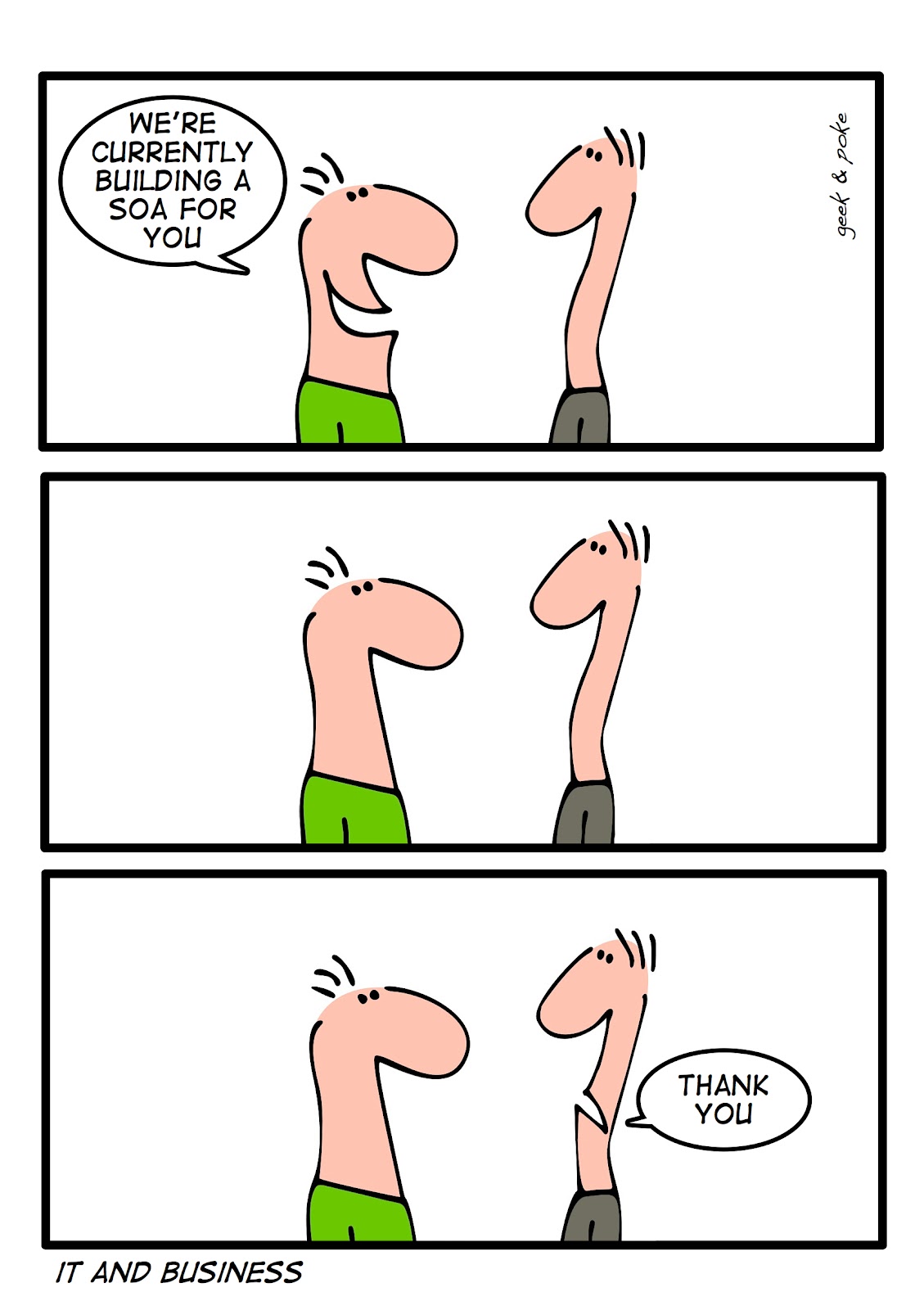
This week I’ve been attending a cloud architecture workshop. Not to architect a cloud for anyone in particular but to learn what the approach to architecting clouds should be. This being an IBM workshop there was, of course, lots of Tivoli this, WebSphere that and Power the other. Whilst the workshop was full of good advice I couldn’t help of thinking of this cartoon from 2008:

Courtesy geekandpoke.typepad.com

Just replace the word ‘SOA’ with ‘cloud’ (as ‘SOA’ could have been replaced by ‘client-server’ in the early nineties) and you get the idea. As software architects it is very easy to get seduced by technology, especially when it is new and your vendors, consultants and analysts are telling you this really is the future. However if you cannot explain to your client why you’re building him a cloud and what business benefit it will bring him then you are likely to fail just as much with this technology as people have with previous technology choices.

On Being a Versatilist

For some time now I’ve been discussing the idea of a versatilist as someone whose numerous roles (across business, science and the arts) assignments and experiences enable them to synthesize knowledge in new and exciting ways that may not have been possible if only one of these viewpoints were taken. I truly believe that this is such an interesting and fruitful topic that I have teamed up with David Evans, Principal Consultant and Owner at Koan Solutions Ltd and created a new blog on the topic of versatilism and what being a versatilist means.Check out our new blog The Versatilist Way and give us your thoughts and ideas.

What Now for Internet Piracy?

So SOPA is to be kicked into the long grass which means it is at least postponed if not killed altogether. For those who have not been following the Stop Online Piracy Act debate, this is the bill proposed by a U.S Republican Representative to expand the ability of U.S. law enforcement to fight online trafficking in copyrighted intellectual property (IP) and counterfeit goods. Supporters of SOPA said it would protect IP as well as the jobs and livelihoods of people (and organisations) involved in creating books, films music, photographs etc. Opponents reckoned the legislation threatened free speech and innovation and would enable law enforcement officers to block access to entire internet domains as well as violating the First Amendment. Inevitably much of the digerati came out in flat opposition of SOPA and staged an internet blackout on 18th January where many sites “went dark” and Wikipedia was unavailable altogether. Critics of SOPA cited that the fact the bill was supported by the music and movie industry was an indication that it was just another way of these industry dinosaurs protecting their monopoly over content distribution. So, a last minute victory for the new digital industry over the old analogue one?And yet…

Check out this TED talk by digital commentator Clay Shirky called Why SOPA is a bad idea. Shirky in his usual compelling way puts a good case for why SOPA is bad (the talk was published before the recent announcement on the bill being postponed) but the real interest for me in this talk was from the comments about it. There are many people saying yes SOPA may be a bad bill but there is nonetheless a real problem with content being given away that should otherwise be paid for and that content creators (whether they be software developers, writers or photographers) are simply losing their livelihoods because people are stealing their work. Sure, there are copyright laws that are meant to prevent this sort of thing happening but who can really chase down the web sites and peer-to-peer networks that “share” content they have not created or paid for? SOPA may have been a bad bill and really have been about protecting the interests of large corporations who just want to carry on doing what they have always done without having to adapt or innovate. However without some sort of regulation that protects the interests of individuals or small start-ups wishing to earn a living from their art, killing SOPA has not moved us forward in any way and certainly not protected their interests. Unfortunately some sort if internet regulation is inevitable.

For a historical perspective of why this is likely to be so, see the TED talk by the Liberal Democrat Paddy Ashdown called The global power shift. Ashdown argues that “where power goes governance must follow” and that there is plenty of historical evidence showing what happens when this is not the case (the recent/current financial meltdown to name but one).

So SOPA may be dead but something needs to replace it and if we are to get the right kind of governance we must all participate in the debate else the powerful special interest groups will get their own way. Clay Shirky argued that if SOPA failed to be passed it would be replaced by something else. Now then is our chance to ensure that whatever that is, is right for content creators as well as distributors.

Architecting Out Complexity

Complexity kills. Complexity sucks the life out of users, developers and IT. Complexity makes products difficult to plan, build, test and use. Complexity introduces security challenges. Complexity causes administrator frustration.

So said Ray Ozzie ex-Microsoft Chief Software Architect and creator of Lotus Notes.

Complexity, or more precisely, overly complicated systems (not to be confused with complex systems) is one of the key anti-patterns architects must continuously fight against. Complexity is caused not just by adding additional and unwanted functionality (although that certainly does not help) but also by muddled architectural thinking as well as poorly made architectural decisions. Here’s the real problem though, the initial architecture of almost any system, unless it borrows very heavily from other, similar, architectures will rarely be without complexity. There will almost always be refinements that can be made, over time, that remove complexity and make for a cleaner and more streamlined design. Sometimes you may even need to throw away the initial architecture and start again, using what you have learnt from the initial architecture to take out complexity. Frederick Brooks (author of The Mythical Man Month) famously said of software designs “plan to throw one away, you will anyway“.

The other problem with complexity in systems is that it tends to increase over time due to software entropy. As more changes are made, some not envisaged by the architect because change cases were not adequately thought through, a system naturally becomes more complicated and harder to maintain. It almost seems that the lifecycle of a system could be represented by the complexity curve in the diagram below.

Complexity does not just apply to systems, it also applies to whole styles of architecture. Cloud computing would still seem to be fairly early on in the complexity curve in this respect. Cloud computing is almost the ultimate in information hiding. Just put everything in the cloud and get what you want when you want it. If you’re inside the cloud looking out however you need to deal with a whole lot of pain to create that outward facing simplicity. If you’re a cloud architect therefore you need to understand and design for that complexity otherwise over time our clouds will become weighed down with out of date junk that no one wants. This is definitely a topic I’ll be returning to over the course of 2012.

Architecting and Social Media

The arguments for and against the rise of user generated content on the web continue to rage. Depending on which side of the debate you take we are either on an amoral downward spiral of increasingly meaningless content being generated by amateurs (for free) that is putting the professional writers, musicians, software developers, photographers etc out of work as well as ruining our brains or are entering a new age where the combination of an unbounded publishing engine and the cognitive surplus many people now have means we are able to build a better and more cooperative world.Like most things in life the truth will not be at one of these polar opposites but somewhere in between. Seth Godin makes an interesting point in a recent blog entry that “lifestyle media isn’t a fad it’s what human beings have been doing forever, with a brief, recent interruption for a hundred years of professional media along the way”. He goes on to say “we shouldn’t be surprised when someone chooses to publish their photos, their words, their art or their opinions. We should be surprised when they don’t.”

After all, given the precarious nature of the press in the UK at the moment with stories being obtained through all sorts of dubious means the professionals can hardly be seen as holding the ethical or moral high ground.

The possibilities for creativity, and building interesting and innovative solutions out of this mixed bag of social media self-publishing is going to be the place where architects are going to have a fertile ground over the coming years. A nice example of this is Flipboard which if you have an iPhone or iPad you should definitely download. This free app is a “social magazine” that extends links your friends and contacts are sharing on Facebook, Twitter, Linkedin, 500px and others into beautifully packaged “articles”. It can also pull in content from a raft of other online content. It’s a great example of what architects should be doing, namely taking existing components and assembling them in interesting and innovative ways.

Computing: The Human Experience

Grady Booch, IBM Fellow and Chief Scientist for Software Engineering in IBM Research has kicked off an initiative to produce a documentary on the history of computing called Computing: The Human Experience.  This is a crowd sourcing initiative for which Grady is trying to raise $25,000 by January 2nd to get the project underway. It’s an all or nothing model, the project must be fully funded before time expires or no money changes hands.
I guess you may ask why you should contribute funds to an initiative like this in these austere times when there are far better causes that could take care of your $$$$. Here are three reasons:

  1. If you are reading this blog you are almost certainly involved at some level in computing. You have helped, or still are helping, change the world in fundamental and unprecedented ways, ways that affect pretty much everyone who walks the face of the planet right now. Isn’t it time that story was told?
  2. Computing more than any other industry has its roots at a very personal level. How many great computing ideas have started in kid’s bedrooms, dormitories or their parent’s garages? You can now help by making your own personal contribution. 
  3. You can donate as little as one dollar, a lot less than your first latte of the day or final glass of alcoholic beverage in the evening. Forego that and spend it on this instead, you could even get a hand written letter of thanks from Grady.

If you do donate, or even if you don’t, make sure you tweet it, blog it, Tumblr it or Facebook it so all your friends know about this.

Social Objects as Instruments of Architecture

According to Hugh MacLeod a social object:

is the reason two people are talking to each other, as opposed to talking to somebody else.

also:

social networks are built around social objects, not vice versa. The latter act as “nodes”. The nodes appear before the network does.

In discussions around architecture there can often be much confused talk around what is needed, what an architecture looks like and what decisions need to be made in order to make it so. There are three useful architectural social objects that help cystalise our thoughts and  allow a network of related artefacts to be created. These are:

  • Use Cases or Scenarios – Illustrate what I am trying to do via real-world examples that use human actors to illustrate what we are trying to achieve.
  • Architecture Overview – The main architectural elements (components) that the system is comprised of.
  • Architecture Decisions – What decisions am I making, what options did I consider and why did I choose the ones I did.

These social objects seem to apply to all levels of architecture from the smallest application to the largest enterprise architecture. Of course they are by no means all you need but serve as a pretty good starting point for all that follows.