Educating an IT Workforce for the 21st Century

A report on the BBC Today programme this morning argues that the “Facebook generation needs better IT skills” and that UK schools should be providing courses in programming at GCSE. The report bemoaned the fact that so called Information and Communications Technology (ICT) GCSEs did little more than teach students how to use Microsoft Office programmes such as Word and Excel and did not prepare students for a career in IT. The backers of this report were companies like Google and Microsoft.This raises an interesting question of who should be funding such education in these austere times. Is it the role of schools to provide quite specific skills like programming or should they be providing the basics of literacy and numeracy as well as the more fundamental skills of creativity, communication and collaboration and leave the specifics to the industries that need them? Here are some of the issues related to this:

  1. Skills like computer programming are continuously evolving and changing. What is taught at 14 – 16 today (the age of GCSE students in the UK) will almost certainly be out of date when these students hit the work force at 21+.
  2. The computer industry, just like manufacturing before it, long ago sent out the message to students that programming skills (in Western economies at least) were commoditised and better performed by the low-cost economies of the BRIC nations (and now, presumably, the CEVITS).
  3. To most people computers are just tools. Like cars, washing machines and mobile phones they don’t need to know how they work, just how to use them effectively.
  4. Why stop at computer programming GCSE? Why not teach the basics of plumbing, car mechanics, cookery and hairdressing, all of which are in great demand still and needed by their respective industries.
  5. Public education (which essentially did not exist before the 19th century, certainly not for the masses) came about to meet the needs of industrialism and as such demanded skills in left-brained, logical thinking skills rather than right brained, creative skills (see Sir Ken Robinson’s TED talk on why schools kill creativity). As a result we have a system that rewards the former rather than the latter (as in “there’s no point in studying painting or music, you’ll never get a job in that”).

In an ideal world we would all be given the opportunities to learn and apply whatever skills we wanted (both at school and throughout life) and have that learning funded by the tax payer on the basis it benefits society as a whole. Unfortunately we don’t live in that ideal world and in fact are probably moving further from it than ever.

Back in the real world therefore industry must surely fund the acquiring of those skills. Unfortunately in many companies education is the first thing to be cut when times are hard. The opposite should be the case. One of the best things I ever did was to spend five weeks (yes that’s weeks not days), funded entirely by IBM, learning object-oriented programming and design. Whilst five weeks may seem like a long time for a course I know this has paid for itself many, many times over by the work I have been able to do for IBM in the 15 years since attending that course. Further, I suspect that five weeks intensive learning was easily equivalent to at least a years worth of learning in an educational establishment.

Of course such skills are more vital to companies like Google, Microsoft and IBM than ever before. Steve Denning in an article called Why Big Companies Die in Forbes this month quotes from an article by Peggy Noonan in the Wall Street Journal (called A Caveman Won’t Beat a Salesman). Denning uses a theory from Steve Jobs that big companies fail when salesmen and accountants are put in charge of and who don’t know anything about the product or service the company make or how it works. Denning says:

The activities of these people [salesmen and accountants] further dispirit the creators, the product engineers and designers, and also crimp the firm’s ability to add value to its customers. But because the accountants appear to be adding to the firm’s short-term profitability, as a class they are also celebrated and well-rewarded, even as their activities systematically kill the firm’s future.

Steve Jobs showed that there was another way.  Namely, to keep playing the offense and focus totally on adding value for customers by creating new and innovative new products. By doing that you can make more money than the companies that are milking their cash cows and focused on making money rather than products.

Companies like Google and Microsoft (and IBM and Apple) need people fully trained in the three C’s (creativity, communication and creativity) who can then apply these to whatever task is most relevant to the companies bottom line. It’s the role of those companies, not government, to train people in the specifics.

Interestingly Seymour Papert (who co-invented the Logo programming language) used programming as a tool to improve the way that children think and solve problems. Papert used Piaget‘s work of cognitive development (that showed how children learn) and used Logo as a way of improving their creativity.

Finally, to see how students themselves view all this see the article by Nikhil Goyal’s (a 16-year-old junior at Syosset High School in New York) who states: “for the 21st century American economy, all economic value will derive from entrepreneurship and innovation. Low-cost manufacturing will essentially be wiped out of this country and shipped to China, India, and other nations” and goes on to propose that
“we institute a 21st century model of education, rooted in 21st century learning skills and creativity, imagination, discovery, and project-based learning”. Powerful stuff for one so young, there may yet be hope for us.

Parkinson’s Law of Triviality (Applied to Architecture)

Parkinson’s Law of Triviality (as proposed by C. Northcote Parkinson in 1957) is that people give disproportionate weight to trivial issues. Parkinson gives as an example a hypothetical (planning) committe deliberating on the building of a nuclear power plant and a bicycle shed. Parkinson stated that “the time spent on any item of the agenda will be in inverse proportion to the sum involved.” Clearly a nuclear reactor is vastly expensive and complicated and the average person is unlikely to understand it because it is so far outside the realms of their daily experience. A bike shed, on the other hand, everyone understands (or thinks they do, which can be even more dangerous). The result is that people will be reluctant to discuss for long the nuclear reactor either because they assume those working on it understand it or because they are to fearful of making themselves look foolish in front of the experts. The bike shed however can result in endless discussions because everyone involved wants to add their “feature” and show that they have contributed. While discussing the bike shed, debate rages over what the best choice of roofing should be, whether there should be windows, whether it should be fully enclosed with walls and a door etc, etc rather than whether the shed is a good idea or not.Parkinson’s Law of Triviality is something that frequently creeps into architecture discussions. When requirements are being discussed and how best to realize them architecturally it is frequently the case that when the domain under discussion consists of parts that are familiar and ones that are not it is the former that will often receive inordinate amounts of discussion whereas the latter do not (but usually should). A good example to illustrate this is that of e-commerce systems. Because most people have used such systems everyone will have an opinion on the bits they are familiar with (the actual look and feel of the shopping experience for example, do you call it a shopping basket or a trolley, do you allow goods to be placed in the basket before you have logged in or registered and so on). The part of the system that deals with payment however (i.e. that goes off in the background and does credit checks etc) or checking stock level is not seen so people will probably have less of an opinion on it. This part, at least as far as the web site owner is concerned, is the most important however because if that does not work he will lose money. Worse however is if the “payments specialist” says that this is the way payments will work, and no one else feels they have the expertise or authority to challenge her. Doing something because that’s the way we always do it is an example of the Golden Hammer anti-pattern and does not always result in the most innovative or creative new systems.

So how to protect against falling foul of Parkinson’s Law of Triviality?

  1. Good architects need to develop deep domain knowledge and know how to, and be fearless in doing so, challenge expert opinion. Frequently appearing foolish by challenging the blindingly obvious is a small price to pay for occasionally highlighting a problem which everyone else overlooked because they were following conventional wisdom.
  2. Ensure complex problems receive proportionately more discussion than simple ones. In other words cut the discussion of addressing the simple problem sooner to allow time to discuss the complex ones. Better still if in a meeting there are several problems to be discussed prioritise them by complexity and start with the most complex first. Leaving simpler ones till the end means you can rush those through when everyone gets tired or you are out of time.
  3. Recognise that everyone has an equal say and it is often the people who know least about the problem that ask the daft, but hard, questions. This of course would seem to go against number 1. If everyone is an expert doesn’t that mean no one will be naive enough to ask the simple but challenging questions? No. A good team has a diverse mix of skills, knowledge and opinions and should allow everyone to comment.
  4. Leave your ego at the meeting room door and do not use your relative position in the hierarchy of the company to trivialise other peoples ideas or prevent constructive discussion because it is not “going your way”.
  5. Finally capture all decisions in a systematic way (recording at the very least what the decision was, what options were discussed, the rationale for choosing the one you did and any related decisions or implications).

What Can Architects Learn from Steve Jobs

I’ve just finished reading Steve Jobs by Walter Isaacson. In case there is anyone out there who doesn’t know it yet, this is the authorised biography that Jobs asked Isaacson to write which was completed a few weeks before Jobs untimely death aged 56 last month. Jobs insisted that Isaacson would have complete control over the contents of the book saying he would not even read it before it was published adding “I don’t have any skeletons in my closet that can’t be allowed out”.Jobs is clearly a very complex personality, on the one hand a creative genius whose zen like focus on simplicity and efficiency helped create some of the most beautiful and useful gadgets of our time (some of which we never even knew we needed) whilst on the other he was a bully and a tyrant who knew exactly how to “size people up, understand their inner thoughts, and know how to relate to them, cajole them, or hurt them at will”. One of jobs girl friends, who later went on to found a mental health resource network in California, even went so far to say that she thought Jobs suffered from Narcissistic Personality Disorder (NPD) in which the individual is described as being excessively preoccupied with issues of personal adequacy, power, prestige and vanity.

Whilst it is to be hoped that NPD is not a prerequisite for being a software architect Jobs did have vision and understanding of IT that we as architects can learn from. Six big ideas that stand out in this respect are:

  1. Engineering matters. When jobs met with President Obama in 2011 he implored the President to reform the US education system and to create more engineering students. Jobs said “if you could educate these engineers we could move more manufacturing plants here”. Whilst there was always an uneasy tension between engineering and design at Apple Jobs recognised and valued the importance of there being an engineering led rather than sales led team at the top of the company berating companies like Microsoft (under Balmer), IBM (under Akers) and HP (under their last several CEOs) for putting sales people in charge rather than engineers. For software architects, engineering clearly translates to being intimately knowledgeable with the technology you are using, knowing how to put the working parts together. The best architects I know are passionate about technology.
  2. Artistry and design matters just as much as engineering. This is a theme that Jobs emphasises over and over again. From when he dropped out of college and instead took a course on calligraphy to his sometimes maniacal focus on the smallest details of design to make the product as satisfying and aesthetically pleasing as possible. He even emphasized that circuit boards, which no one would ever see once the product was fully assembled, should be laid out in as clean and uncluttered was as possible. It is this aspect of design that most matters for architects. Provided that functionally a system does what it is meant to do within the required constraints and system qualities one could argue it does not matter how messily the software is assembled. Whose going to see it anyway? This misses the point though.Great design, as opposed to just good enough design, means the system will be easier to maintain, take less effort to learn and generally be more enjoyable for those that need to carry on working on it once the architects and developers have moved on.
  3. Simple is better than complex. Apple had a design mantra: “Simplicity is the ultimate sophistication” or as Jobs said “very simple, and we’re really shooting for Museum of Modern Art quality”. Jobs felt that design simplicity should be linked to making products easy to use.So much of the software that we create today is far too complex and feature rich and as a result is very hard to use. People will often say that it has to be like that because just look at all the features you are getting. Unfortunately a lot of the time many of those features are not needed but add to the general bloat of the systems we build making them hard to use as well as difficult to maintain. Sadly building a complex system is often easier than building a simple one and it is not many architects that see value in stripping out functionality rather than adding it.
  4. An unremitting focus on detail is key to creating a great product. Jobs was unique in that he was able to hold both the big picture view as well as zooming in to fine details. He would often sweat over the smallest detail until he was satisfied it was just right. This could be anything from the colour of a screw on the back plate of the iPod to the angle of the bevel on the iPad to make someone want to pick it up. This capacity for holding both the big picture view whilst also being able to zoom right down and question low level details is probably one of the hardest things architects have to do but being able to do so gives a definite advantage and enables greater integrity as well as better execution of vision.
  5. Customers don’t always know what they want. In September 1982 when Jobs and his team were designing the original Macintosh he held a retreat for the Mac team near Monteray where he gave a presentation on his thoughts for the Mac. At the end someone asked whether or not they should do some market research to find out what customers wanted. “No”, replied Jobs, “because people don’t know what they want until we’ve shown them”. He then pulled out a device the size of a desk diary and flipped it open, it turned out to be a mock-up of a computer that could fit into your lap with a keyboard and screen hinged together like a notebook. “This is my dream of what we will be making in the mid- to late eighties”, Jobs said. Apple supposedly never did do any market research preferring to follow the Henry Ford approach who said he never asked what people wanted because they would have just asked for a better horseless carriage. Whilst it is probably the case that people can often see how to make incremental improvements to products they usually cannot see how to make disruptive changes that introduce a who new way of doing things, possibly making everything that went before it redundant. It is the job of the architect to show what is in the realms of the possible by creating new and innovative systems.
  6. Putting things together in new and creative ways is sometimes more important than inventing things. Jobs was not the first to market with an MP3 player, a mobile phone or a tablet computer. Others had already innovated and built these things. What Jobs and Apple did were to tweak things that already existed. As Isaacson says “he had noticed something odd about the cell phones on the market: They all stank, just like portable music players used to”. Jobs applied his design skills to these and came up with a (far) better product and in fact a whole new platform as well (i.e. the computer as the digital hub. Architects to need to learn that its often putting together existing components in new and innovative ways that really counts and gives a competitive and business advantage.

Creativity at Scale

I stumbled across this article by Grady Booch today whilst doing some research on complex systems. It’s quite old (well 3 years is an age in this profession) but what it has to say about developing complex systems is, I believe, timeless. In particular I loved Grady’s point about the importance of “developing social structures that encourage innovation whilst still preserving predictability”. Interestingly another post by Seth Godin says:  

The challenge of our time may be to build organizations and platforms that engage and coordinate the elites, wherever they are. After all, this is where change and productivity come from.

Seth’s definition of an “elite” is anyone who is “actively engaged in new ideas, actively seeking out change, actively engaging.

The internet is a great platform for bringing people together. The challenge is in how to scale the creativity, that can be easily bought to focus in a small, co-located team, across the internet. The boundaries of the enterprises that used to do this are beginning to crumble. There is often more creativity outside the enterprise than is in it and new architectures (new platforms) need to learn how to make use of this. This is more than just what has been happening with the open source movement, where a group of people come together to build new products, its about how to use creativity at scale to build new platforms.

~~~~

Spookily (well it is Halloween) and with a great bit of webendipity just as I was about to push the publish button on this article up popped in my twitter feed this article by my colleague Jeremy Caine about platforms (e.g. Facebook, iTunes, Twitter) and the creatives that build them.

Blackberry’s Perfect Storm

A perfect storm is defined as being: a critical or disastrous situation created by a powerful concurrence of factors.A perfect storm is certainly what RIM, makers of the Blackberry, have been experiencing recently. For three days, starting on 10th October a problem caused by a router in an unassuming two-storey building in Slough, UK affected almost every one of its users around the world. Not only were users unable to Twitter, or Facebook, more seriously, those users who rely on their Blackberrys for email to do their business may have lost valuable work. Whilst many commentators may have made light of the situation, because people could no longer tweet their every movement, there is a far more serious message here which is that as a civilisation we are now completely dependent on software and hardware technology that runs our daily lives.

Here’s what Blackberry had to say on their service bulletin board on 11th October, mid-way through the crisis:

The messaging and browsing delays that some of you are still experiencing were caused by a core switch failure within RIM’s infrastructure. Although the system is designed to failover to a back-up switch, the failover did not function as previously tested…

Unfortunately for Blackberry it was not only this technical and process failure that formed part of their perfect storm but two other factors, they could not hoped to have predicted, also occurred recently. One was the launch of the latest iPhone 4S from Apple which was released the very same week as Blackberry’s network failure. The other is the allegation that Blackberry’s, or more precisely the Blackberry Messaging Service (BBM), were implicated in the recent riots that took place in London and other UK cities in the summer.  For many teens armed with a BlackBerry, BBM has replaced text messaging because it is free, instant and more part of a much larger community than regular SMS. Also, unlike Twitter or Facebook, many BBM messages are untraceable by the authorities.

From an IT architecture point of view clearly the technical and process failure of such a crucial data centre should just not have been allowed to happen. In some ways Blackberry has been a victim of its own success with the number of users growing from 10 million in 2005 to 70 million now without a corresponding increase in capacity of its network and fully functioning failover facility. However the more interesting, and in some ways more intractable, problem is the competitive, sociological and even ethical aspects of the situation. When Apple launched the first iPhone back in 2007 they changed forever the way people interacted with their phones. Some people have observed that the tactile way in which people “stroke” an iPhone rather than jab at tiny buttons has led to their more widespread adoption. Clearly a case of getting the human-computer interface right paying great dividends. Who would have thought however that the very aspect that once made Blackberry’s so popular with business users (their security) could backfire on them in quite such a significant way? Architecture (and design) is not just about getting the right features at the right price it is also about thinking through the likely impact of those features in contexts that may not initially have been envisaged.

Steve Jobs 1955 – 2011

During the coming days and weeks millions of words will be written about Steve Jobs, many of them on devices he created. Why does the world care so much about an American CEO and computer nerd? For those of us that work with technology, and hope to use it to make the world a better place, the reason Steve Jobs was such a role model is that he not only had great vision and a brilliant understanding of design but also knew how to deliver technology in a form that was usable by everyone, not just technophiles, nerds and developers. Steve Jobs and Apple have transformed the way we interact with data, and the way that we think about computing, moving it from the desktop to the palm of our hands. As IT becomes ever more pervasive we could all learn from that and maybe even hope to emulate Steve Jobs a little.

Reusable Assets for Architects

Architects are fond of throwing terms around which have mixed, ambiguous or largely non-existent formal definitions. Indeed one of the great problems (still) of our profession is that people cannot agree on the meanings of many of the terms we use everyday. There is no ‘common language’ that all architects speak. If you want to see some examples look up terms like ‘enterprise architecture’ or ‘cloud computing’ in wikipedia then look at what’s written in the ‘discussion’ section.Three terms that often get misused or are used interchangeably fall under the general category of reusable assets. A reusable asset is something which has been proven to be useful, in some form or another, in one project or architectural definition and could be reused elsewhere. The Object Management Group (OMG) defines a reusable asset as one that: provides a solution to a problem for a given context. See the OMG Reusable Asset Specification. Those of you familiar with the classic Design Patterns book by the so called “Gang of Four” will recognise elements of this definition from that book. Indeed reusable assets are a generalization of design patterns. Three other reusable assets, which are of particular use to an architect, are:

  • Reference architectures
  • Application frameworks
  • Industry solutions

What do each of these mean, what’s the difference and when (or how) can they be used?

A reference architecture is a template which shows, usually at a logical level, a set of components and their relationships. Reference architectures are usually created based on perceived best-practice at the time of their creation. This is both a good thing (you get the latest thinking) but can also be bad (they can become dated). Reference architectures are usually associated with a particular domain which could either be a business (e.g. IBM’s Insurance Application Architecture or IAA) or industry (such as a banking reference architecture) or technology domain (e.g. cloud and SOA). Ideally reference architectures will not preordain any technology and will allow multiple vendors products to be mapped to each of the components. Sometimes vendors use reference architectures as a way of placing their tools or products into a cohesive set of products that work together.

An application framework represents the partial implementation of a specific area of a system or an application. Reference architectures may be composed of a number of application frameworks. Probably one of the best known application frameworks is Struts from the Apache open source organisation. Struts is a Java implementation of the Model-View-Controller pattern which can be ‘completed’ by developers for their own applications.

Finally an industry solution is a set of pre-configured (or configurable) software components designed to meet specific business requirements of a particular industry. Industry solutions are usually created and sold by software vendors and are based on their own software products. However the best solutions adhere to open standards and would allow other vendors products to be used as well. Most organisations want to avoid vendor lock-in and are unlikely to take the “whole enchilada”. Industry solutions may be implementations of one or more reference architectures. For example IBM’s Retail Industry Framework implements reference architectures from a number of domains (supply chain, merchandising and product management and so on).

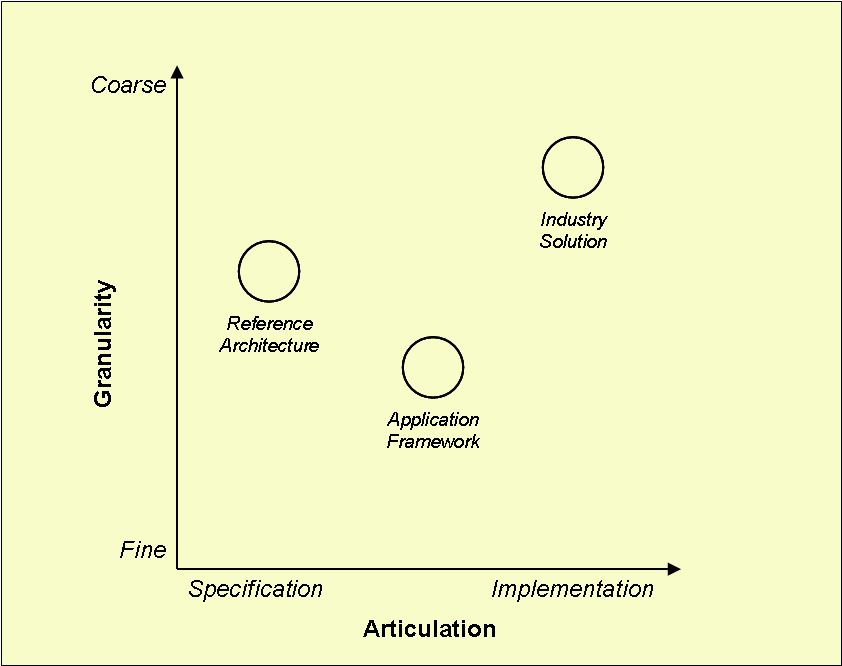
Assets can be considered in terms of their granularity (size) and their level of articulation (implementation). Granularity is related to both the number of elements that comprise the asset and the asset’s impact on the overall architecture. Articulation is concerned with the extent to which the asset can be considered complete. Some assets are specifications only, that is to say are represented in an abstract form, such as a model or document. Other assets are considered to be complete implementations and can be instantiated as is, without modification. Such assets include components and existing applications. The diagram below places the three assets I’ve discussed above in terms of their granularity and articulation.

There are of course a whole range of other reusable assets: design patterns, idioms, components, complete applications and so on. These could be classified in a similar way. The above are the ones that I think architects are most likely to find useful however.

Plus Two More

In my previous post on five architectures that changed the world I left out a couple that didn’t fit my self-imposed criteria. Here, therefore, are two more, the first of which is a bit too techie to be a part of everyone’s lives but is nonetheless hugely important and the second of which has not changed the world yet but has pretty big potential to do so.

IBM System/360
Before the System/360 there was very little interchangeability between computers, even from the same manufacturers. Software had to be created for each type of computer making them very difficult to develop applications for as well as maintain. The System/360 practically invented the concept of architecture as applied to computers in that it had an architecture specification that did not make any assumptions on the implementation itself, but rather describes the interfaces and the expected behavior of an implementation. The System/360 was the first family of computers designed to cover the complete range of applications, from small to large, both commercial and scientific. The development of the System/360 cost $5 billion back in 1964, that’s $34 billion of today’s money and almost destroyed IBM.

Watson
Unless you are American you had probably never heard of the TV game show called Jeopardy! up until the start of 2011. Now we know that it is a show that “uses puns, subtlety and wordplay” that humans enjoy but which computers would get tied up in knots over. This, it turns out, was the challenge that David Ferrucci, the IBM scientist who led the four year quest to build Watson, had set himself to compete live against humans in the TV show.

IBM has “form” on building computers to play games! The previous one (Deep Blue) won a six-game match by two wins to one with three draws against world chess champion Garry Kasparov in 1997. Chess, it turns out, is a breeze to play compared to Jeopardy! Here’s why.
Chess…

  •  §Is a finite, mathematically well-defined search space.
  • Has a large but limited number of moves and states.
  • Makes everything explicit and has unambiguous mathematical rules which computers love.

Games like Jeopardy! play on the subtleties of the human language however which is…

  • Ambiguous, contextual and implicit.
  • Grounded only in human cognition.
  • Can have a seemingly infinite number of ways to express the same meaning.

According to IBM Watson is “built on IBM’s DeepQA technology for hypothesis generation, massive evidence gathering, analysis, and scoring.” Phew! The point of Watson however is not its ability to play a game show but in the potential to “weaves its fabric” into the messiness of our human lives where data is not kept in nice ordered relational databases but is unstructured and seemingly unrelated but nevertheless can sometimes have new and undiscovered meaning. One obvious application is in medical diagnosis but it could also be used in a vast array of other situations from help desks through to sorting out what benefits you are entitled to. So, not world changing yet but definitely watch this space.

Five Software Architectures That Changed The World

Photo by Kobu Agency on Unsplash

“Software is the invisible thread and hardware is the loom on which computing weaves its fabric, a fabric that we have now draped across all of life”.

Grady Booch

Software, although an “invisible thread” has certainly had a significant impact on our world and now pervades pretty much all of our lives. Some software, and in particular some software architectures, have had a significance beyond just the everyday and have truly changed the world.

But what constitutes a world changing architecture? For me it is one that meets all of the following:

  1. It must have had an impact beyond the field of computer science or a single business area and must have woven its way into peoples lives.
  2. It may not have introduced any new technology but may instead have used some existing components in new and innovative ways.
  3. The architecture itself may be relatively simple, but the way it has been deployed may be what makes it “world changing”.
  4. It has extended the lexicon of our language either literally (as in “I tried googling that word” or indirectly in what we do (e.g. the way we now use App stores to get our software).
  5. The architecture has emergent properties and has been extended in ways the architect(s) did not originally envisage.

Based on these criteria here are five architectures that have really changed our lives and our world.

World Wide Web
When Tim Berners-Lee published his innocuous sounding paper Information Management: A Proposal in 1989 I doubt he could have had any idea what an impact his “proposal” was going to have. This was the paper that introduced us to what we now call the world wide web and has quite literally changed the world forever.

Apple’s iTunes
There has been much talk in cyberspace and in the media in general on the effect and impact Steve Jobs has had on the world. When Apple introduced the iPod in October 2001 although it had the usual Apple cool design makeover it was, when all was said and done, just another MP3 player. What really made the iPod take off and changed everything was iTunes. It not only turned the music industry upside down and inside out but gave us the game-changing concept of the ‘App Store’ as a way of consuming digital media. The impact of this is still ongoing and is driving the whole idea of cloud computing and the way we will consume software.

Google
When Google was founded in 1999 it was just another company building a search engine. As Douglas Edwards says in his book I’m Feeling Lucky “everybody and their brother had a search engine in those days”. When Sergey Brin was asked how he was going to make money (out of search) he said “Well…, we’ll figure something out”. Clearly 12 years later they have figured out that something and become one of the fastest growing companies ever. What Google did was not only create a better, faster, more complete search engine than anyone else but also figured out how to pay for it, and all the other Google applications, through advertising. They have created a new market and value network (in other words a disruptive technology) that has changed the way we seek out and use information.

Wikipedia
Before WIkipedia there was a job called an Encyclopedia Salesman who walked from door to door selling knowledge packed between bound leather covers. Now, such people have been banished to the great redundancy home in the sky along with typesetters and comptometer operators.

If you do a Wikipedia on Wikipedia you get the following definition:

Wikipedia is a multilingual, web-based, free-content encyclopedia project based on an openly editable model. The name “Wikipedia” is a portmanteau of the words wiki (a technology for creating collaborative websites, from the Hawaiian word wiki, meaning “quick”) and encyclopedia. Wikipedia’s articles provide links to guide the user to related pages with additional information.

From an architectural point of view Wikipedia is “just another wiki” however what it has bought to the world is community participation on a massive scale and an architecture to support that collaboration (400 million unique visitors monthly more than 82,000 active contributors working on more than 19 million articles in over 270 languages). Wikipedia clearly meets all of the above crtieria (and more).

Facebook
To many people Facebook is social networking. Not only has it seen off all competitors it makes it almost impossible for new ones to join. Whilst the jury is still out on Google+ it will be difficult to see how it can ever reach the 800 million people Facebook has. Facebook is also the largest photo-storing site on the web and has developed its own photo storage system to store and serve its photographs. See this article on Facebook architecture as well as this presentation (slightly old now but interesting nonetheless).

I’d like to thank both Grady Booch and Peter Eeles for providing input to this post. Grady has been doing great work on software archeology  and knows a thing or two about software architecture. Peter is my colleague at IBM as well as co-author on The Process of Software Architecting.