Software Architecture Zen is Five Years Old

So Software Architecture Zen is five years old (actually on 28th July, I missed my own birthday).

I started this blog on the Blogger platform and moved to WordPress earlier this year. Whilst my WordPress following has not built up to the same level I had on Blogger I far prefer the tools and whole look and feel offered by WordPress so do not regret the move.

I’ve had just over 103,000 hits in total across both platforms in five years. Not quite up there with the Joel on Software blogs of the world but not too shabby either I think. Here are my top five posts of the last five years:

  1. Architecture vs. Design
  2. How to Create Effective Technical Presentations
  3. On Thinking Architecturally
  4. Two Diagrams All Software Architects Need
  5. The Moral Architect

I’m pleased the last one is up there as it’s a topic dear to my heart and one I plan to blog on more in the future. Here’s to the next five years!


Architecting Out Complexity

Complexity kills. Complexity sucks the life out of users, developers and IT. Complexity makes products difficult to plan, build, test and use. Complexity introduces security challenges. Complexity causes administrator frustration.

So said Ray Ozzie ex-Microsoft Chief Software Architect and creator of Lotus Notes.

Complexity, or more precisely, overly complicated systems (not to be confused with complex systems) is one of the key anti-patterns architects must continuously fight against. Complexity is caused not just by adding additional and unwanted functionality (although that certainly does not help) but also by muddled architectural thinking as well as poorly made architectural decisions. Here’s the real problem though, the initial architecture of almost any system, unless it borrows very heavily from other, similar, architectures will rarely be without complexity. There will almost always be refinements that can be made, over time, that remove complexity and make for a cleaner and more streamlined design. Sometimes you may even need to throw away the initial architecture and start again, using what you have learnt from the initial architecture to take out complexity. Frederick Brooks (author of The Mythical Man Month) famously said of software designs “plan to throw one away, you will anyway“.

The other problem with complexity in systems is that it tends to increase over time due to software entropy. As more changes are made, some not envisaged by the architect because change cases were not adequately thought through, a system naturally becomes more complicated and harder to maintain. It almost seems that the lifecycle of a system could be represented by the complexity curve in the diagram below.

Complexity does not just apply to systems, it also applies to whole styles of architecture. Cloud computing would still seem to be fairly early on in the complexity curve in this respect. Cloud computing is almost the ultimate in information hiding. Just put everything in the cloud and get what you want when you want it. If you’re inside the cloud looking out however you need to deal with a whole lot of pain to create that outward facing simplicity. If you’re a cloud architect therefore you need to understand and design for that complexity otherwise over time our clouds will become weighed down with out of date junk that no one wants. This is definitely a topic I’ll be returning to over the course of 2012.

Challenging What Architects Do

For most of this year I’ve been fortunate (sic) enough to travel around several countries (and indeed continents) delivering a series of architecture workshops to a client. These workshops aim to teach, through the use of instructor led case studies, best practice approaches to building solution architectures. The workshops take a holistic approach to developing architecture by ensuring both the application as well as infrastructure aspects are considered together and both the functional and non-functional requirements are taken into account.

An enjoyable side-effect of these workshops is I get to meet lots of different people who like to challenge the approach and test my understanding (I sometimes think I’m learning more than the workshop participants). Here’s one such challenge (paraphrased) I received recently: “The problem with architects and the work products they produce (for example models built using the Unified Modeling Language) is that the work products become an end in their own right and we can easily lose track of the fact that actually what we want to build is a system with running code on real hardware”. The clear implications behind this challenge could be described via three architecture anti-patterns:

  • Antipattern: Architecture Overkill. Symptoms: Architects create work that no one understands or cares about. Multiple artefacts with overlapping content get created that no one actually reads. They are too large, too complex and may even be delivered too late.
  • Antipattern: Ivory Tower Architecture. Symptoms: Architects are out of touch with real-world technical aspects. Instead they just sit in their ivory-towers making their pronouncements (which most of the time no one listens to).
  • Antipattern: Work Creation. Symptoms: The role of the architect becomes self-fulfilling. They create work products which only they understand and therefore need more architects to help create these work products.

Here’s my response:

  • Any architectural work product needs to have either an up-stream (e.g. to the business) or down-stream (e.g. to the implementers) justification. Each of these groups of stakeholders needs to be able to recognise how the architecture, as encompassed in the work products, addresses their particular concerns otherwise the work product really is only for its own sake. There are other stakeholders who will have interests or concerns in the architecture but I just focus on these to illustrate my point.
  • The role of the architect needs to be clearly defined and work produced around that role. The role may change as business needs etc evolve but the work created should be in tune with that role and ultimately fulfil the needs of the business. This does not, of course, mean that part of what architects  do is research new technology or try out new ideas. Indeed if they don’t do this the next point will be tricky to fulfil.
  • One of the difficulties with the role of the architect is that it can mean the architect easily becomes out of touch with the latest trends etc in programming. This can be caused by a number of things including: architects are paid too much to do programming, architects are too senior to do programming, architects are too busy to do programming etc. This particular problem is particularly endemic in many services organisations where architects may be charged out at premium rates and where the role of programming is seen as almost too “menial”. What to do? It’s vital that this is not the case. There must always be time allowed in any software architects work day to stay in touch with the stuff that gives him his reason for being.

On Thinking Architecturally

Tim Brown (CEO of IDEO) has written a great book on design thinking called Change by Design. Check out the link to see his mind-map of what the book is about.The basic premise of the book, why its about design thinking rather just design, is that design thinkers take a far more holistic approach to solving design problems. They use an interdisciplinary approach, think around the problem, including viewing the constraints as enablers rather than what should be fought against, and come up with ideas that would otherwise not have been thought of if ‘ordinary’ design had been applied. One of the case studies Tim uses in the book is the setting up of a live laboratory in the Mayo Clinic in Rochester, Minnesota to develop new approaches to patient care which involved designers, health care professionals, business strategists and patients to develop ideas for the “patient-provider experience”. A methodology called SPARC (See-Plan-Refine-Communicate) was adopted (which is I suspect based on the Deming Cycle) to show how design thinking could be applied not only to product design but also service design.

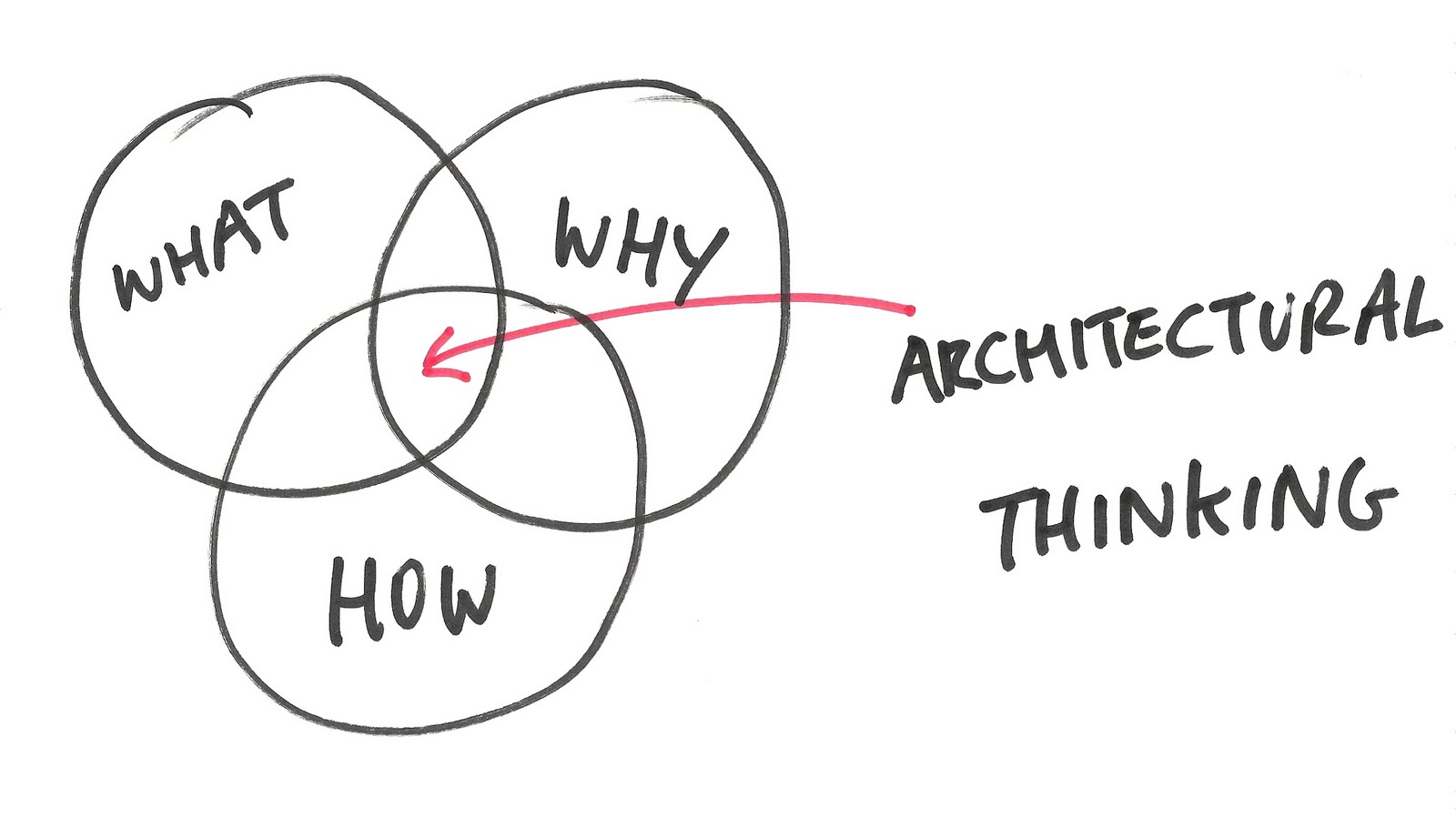
Returning to the mind-map that is on the inside front-cover of Change by Design its two starting points are ‘What’ (is it we are trying to do/solve) and ‘How’ (are we going to approach the design). This fits nicely with my own concept of what we term ‘architectural thinking‘ where we add an additional ‘node’ which is ‘Why’ (are we doing it this way). I prefer to illustrate this as a Venn diagram as shown below. The intersection of the three sets is what we consider when ‘thinking architecturally’.

  • What – The requirements we are trying to address. Architectural thinking focuses is on those requirements (functional, qualities and constraints) we think are architecturally significant in some way.
  • Why – Captures the key decisions we are making. Architectural thinking focuses on the architectural aspects which lead to major structuring, placement or procurement decisions. Could be explicit (as a fully documented decision with options looked at and rational for making the decision we did) or implicit in a diagram or model.
  • How – The design and implementation of the system. Architectural thinking focuses on those elements of the design that are significant to the architecture (maybe patterns applied, key principles adopted etc).

The key thing in all this is that the thinking applies to the significant elements not everything. The key skill of the architect is to understand which things are important and which can be left to someone else to fret over.

Architecture Anti-Patterns: Pattern #6 – Architecture Thinking Not Doing

Anti-Pattern Name: Architecture Thinking Not Doing
General Form:
An organisation or enterprise embarks on an initiative to retrain their designers and developers to be ‘architects’. They set up education classes, assign new roles to their people with the word ‘architect’ in their job title and may even pay them some more money to match their ‘elevated’ status. However after a period of time (could be 6 months, could be longer) the initiative dies, developers just keep developing, designers just keep designing and no true system architectures materialise.
Symptoms and Consequences:

  • People return from training but make no changes to their behaviour. They revert to whatever it was they were doing previously.
  • The person(s) responsible for the initiative move on and as it was “their baby” the initiative dies.
  • Management think that training is sufficient and that once students have been trained they will “know what to do differently”.
  • People want to put into practice what they have learnt but have no idea where to go for help or guidance.

Refactored Solution:

  • Architecture thinking has to be turned into architecture doing. Follow up training with projects which make immediate use of new skills.
  • Identify early on who the real leaders are and get them to mentor others.
  • Obtain a critical mass of core people who will continue to develop their skills and be advocates of the new approach even once the initial hype has died down.
  • Ensure the initiative to train architects has support from the highest (i.e. CxO) level of the organisation.
  • Get buy-in from the business as well as IT. Convince the business of the need for architecture by showing them time to market and quality will improve and their will be less maintenance costs.
  • If the organisation is immature but keen to learn ‘buy-in’ experience either by hiring experienced people or working with good technical consultancies who have a proven track record (or some mix of both).
  • Follow up training with good quality, written down guidance (including guidelines, examples and templates) which is readily available and easily found (preferably in the companies website).
  • As part of the training get a written-down commitment from each student that describes one thing they will do differently as a result of attending this training. Follow this up and see if they did it. If not find out why not.

See Pattern #5

Does Architecture Matter Any More?

I’ve been reading up on the whole cloud/mashups/social computing thing and the above question occurred to me. Within the context of what are essentially several new architectural styles what is the role of the architect in all of this and what exactly is the architecture he or she is trying to create? In attempting to answer this question my mind diverted to an IT architecture course that I have been lucky enough to teach on a number of occasions both inside and outside IBM. The course is called Architectural Thinking. I imagine (hope) that some people reading this will have attended that class and it occurred to me just how clever the people that created the first version of that class back in 1999 were. The key word of course is thinking. It’s not a class about a particular style of architecture, about a particular architectural process and is certainly (thankfully) not about any particular technology. The key part of that class is about how to think about problems and create architectures, often using an existing style or pattern, to come up with solutions to a client’s business problem. The main axiom being that the architecture should drive the technology and not the other way round. In other words it’s about the fundamentals that never go out of style or, to paraphrase Grady Booch:

Architectural styles come and go but the enduring fundamentals (crisp abstractions; clear separation of concerns; balanced distribution of responsibilities; simplicity) endure and never go out of style.

This course is available outside of IBM for clients so if anyone is interested in running the class get in touch with me on here.