What Have Architects Ever Done for Us?

I’ve been thinking about blogging on the topic of what value architects bring to the table in an age of open source software, commoditized hardware and agile development for a while. I’ve finally been spurred into action by re-discovering the famous Monty Python sketch What have the Romans ever done for us? (I often find that thinking of a name for a blog post helps me to formulate the content and structure what I want to say). Here’s the video in case you haven’t seen it.

So, picture the scene…

You are in a meeting with the chief information office (CIO) of a public or private sector enterprise who has been tasked with aligning IT with the new business strategy to “deliver real business value”. The current hot technologies, namely social media, mobile, big data/analytics and cloud, are all being mooted as the thing the organisation needs to enable it to leapfrog the competition and deliver something new and innovative to its customers. The CIO however has been burnt before by an architecture team that seems to spend most of its time discussing new technology, drawing fine looking pictures that adorn their cubicle walls and attending conferences sponsored by vendors. She struggles to see the value these people bring and asks in a frustrated tone “what have architects ever done for us”? What’s your response? Here’s what I think architects should be doing to support the CIO and help her achieve the enterprise’s goals.

  1. Architects bring order from chaos. The world of IT continues to get ever more challenging. Each new architectural paradigm adds more layers of complexity onto an organisations already overstretched IT infrastructure. As more technologies get thrown into this mix, often to solve immediate and pressing business problems but without being a part of any overall strategic vision, IT systems begin to sink into more and more of a chaotic state. One of the roles of an architect is not only to attempt to prevent this happening in the first place (see number 2) but also to describe a future “to-be” state, together with a road map for how to get to this new world. Some will say that this form of enterprise level architecting is fundamentally flawed however I would argue it still has great value provided it is done at the right level of abstraction (not everything is enterprise level) and recognises change will be continuous and true nirvana will never be achieved.
  2. Architects don’t jump on the latest trend and forget what went before. When a new technology comes along it’s sometimes easy to forget that it’s just a new technology. Whilst the impact on end users may be different, the way enterprises go about integrating that technology into their business, still needs to follow tried and tested methods. Remember, don’t throw out the baby with the bath water.
  3. Architects focus on business value rather than latest technology. Technologies come and go, some change the world, some don’t. Unless technology can provide some tangible benefits to the way a business operates it is unlikely to gain a foothold. Architects know that identifying the business value of technology and realising that value through robust solutions built on the technology is what is key. Technology for the sake of technology no longer works (and probably never did).
  4. Architects know how to apply technology to bring innovation.This is subtlety different from 3. This is about not just using technology to provide incremental improvements in the way a business operates but in using technology to provide disruptive innovation that causes a major shift in the way a business operates. Such disruptions often cause some businesses to disappear but at the same time can cause others to be created.
  5. Architects know the importance of “shipping”. According to Steve Jobs “real artists ship”. Delivering something (anything) on time and within budget is one of the great challenges of software development. Time or money (or both) usually run out before anything is delivered.Good architects know the importance of working within the constraints of time and money and work with project managers to ensure shipping takes place on time and within budget.

So there you have it, my take on the value of architects and what you hopefully do for your organisation or clients. Now, if only we could do something about bringing world peace…

A Tale of Two Presentations

Popular consensus would seem to have it that the 2007 presentation by Steve Jobs at MacWorld where he unveiled the iPhone is one of the all time best business presentations ever. Not just in terms of the delivery but also in terms of the impact it had on the world.

As a stark contrast, according to Ron Galloway in the Huff Post Business Blog a recent presentation by Sony introducing the PS4 will likely go down as one of the worst business presentations ever. I’ve not seen the Sony presentation but according to Wired they held reporters hostage for two hours and never actually showed them their new console, just the controller, and revealed very little about what the new console would be like.

Amazing that a company as large and influential as Sony can make so many fundamental presentation mistakes but a salutary lesson to us all I think.

There is some very good presentation advice at the end of the Huff Post blog by the way. So useful it’s worth cutting out and sticking to your presentation notes.

  1. Respect your audience and their time.
  2. Get on stage.
  3. Make your assertion.
  4. Support it with visual evidence.
  5. Repeat your assertion.
  6. Leave the stage.

The Art of What’s Possible (and What’s Not)

One of the things Apple are definitely good at is giving us products we didn’t know we needed (e.g. the iPad). Steve Jobs, who died a year ago this week, famously said “You’ve got to start with the customer experience and work back to the technology — not the other way around”  (see this video at around 1:55 as well as this interview with Steve Jobs in Wired).

The subtle difference from the “normal” requirements gathering process here is that, rather than asking what the customer wants, you are looking at the customer experience you want to create and then trying to figure out how available technology can realise that experience. In retrospect, we can all see why a device like the iPad is so useful (movies and books on the go, a cloud enabled device that lets you move data between it and other devices, mobile web on a screen you can actually read etc, etc). Chances are however that it would have been very difficult to elicit a set of requirements from someone that would have ended up with such a device.

Jobs goes on to say “you can’t start with the technology and try to figure out where you’re going to try and sell it”. In many ways this is a restatement of the well known “golden hammer” anti-pattern (to a man with a hammer, everything appears as a nail) from software development, the misapplication of a favored technology, tool or concept in solving a problem.

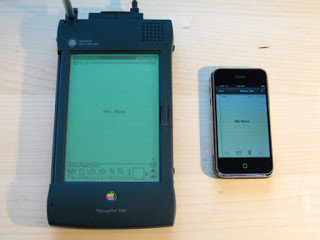
Whilst all this is true and would seem to make sense, at least as far as Apple is concerned, there is still another subtlety at play when building truly successful products that people didn’t know they wanted. As an illustration of this consider another, slightly more infamous Apple product, the Newton Message Pad.

In many ways the Newton was an early version of the iPad or iPhone (see above for the two side by side), some 25 years ahead of its time. One of its goals was to “reinvent personal computing”. There were many reasons why the Newton did not succeed (including it’s large, clunky size and poor handwriting recognition system) however one of them must surely have been that the device was just too far ahead of the technology available at the time in terms of processing power, memory, battery life and display technology. Sometimes ideas can be really great but the technology is just not there to support them.So, whilst Jobs is right in saying you cannot start with the technology then decide how to sell it equally you cannot start with an idea if the technology is not there to support it, as was the case with the Newton. So what does this mean for architects?

A good understanding of technology, how it works and how it can be used to solve business problems is, of course, a key skill of any architect however, equally important is an understanding of what is not possible with current technology. It is sometimes too easy to be seduced by technology and to overstate what it is capable of. Looking out for this, especially when there may be pressure on to close a sale, is something we must all do and be forceful in calling it out when we think something is not possible.

Giving Users What They Want (Maybe)

Tradition has it that users come up with a set of requirements which architects and designers take and turn into “a solution”. That is, a combination of bespoke and off-the-shelf, hardware and software components, that are assembled in such a way they address all the requirements (non-functional as well as functional). Another point of view is that users don’t actually know what they want and therefore need to be guided toward solutions they never knew they needed or indeed knew were possible. Two famous proponents of this approach were Henry Ford who supposedly said:

If I had asked people what they wanted, they would have said faster horses.

which is debunked here and of course Steve Jobs and Apple whose “Eureka” moments continue to give us gadgets we never knew we needed. As Adrian Slywotzky points out here however, the magic that Jobs and Apple seem to regularly perform is actually based on highly focused and detailed business design, continuous refinement through prototyping and a manic attention to the customer experience.In other words it really is 90% perspiration and 10% inspiration.

One thing that both Henry Ford and Steve Jobs/Apple did have in common was also a deep understanding of the technology in their chosen fields of expertise and, more importantly, where that technology was heading.

If, as an architect, you are to have a sensible conversation with users (AKA customers, clients, stakeholders et al) about how to create an architecture that addresses their needs you not only need a good understanding of their business you also need a deep understanding of what technology is available and where that technology is heading. This is a tall order for one persons brain which is why the job of an architect is uniquely fascinating (but also hard work). It’s also why, if you’re good at it, you’ll be in demand for a while yet.

Remember that, even though they may not know it, users are looking at you to guide them not only on what the knowns are but also on what the unknowns are. In other words, it’s your job to understand the art of the possible, not just the art of the common-or-garden.

Educating an IT Workforce for the 21st Century

A report on the BBC Today programme this morning argues that the “Facebook generation needs better IT skills” and that UK schools should be providing courses in programming at GCSE. The report bemoaned the fact that so called Information and Communications Technology (ICT) GCSEs did little more than teach students how to use Microsoft Office programmes such as Word and Excel and did not prepare students for a career in IT. The backers of this report were companies like Google and Microsoft.This raises an interesting question of who should be funding such education in these austere times. Is it the role of schools to provide quite specific skills like programming or should they be providing the basics of literacy and numeracy as well as the more fundamental skills of creativity, communication and collaboration and leave the specifics to the industries that need them? Here are some of the issues related to this:

  1. Skills like computer programming are continuously evolving and changing. What is taught at 14 – 16 today (the age of GCSE students in the UK) will almost certainly be out of date when these students hit the work force at 21+.
  2. The computer industry, just like manufacturing before it, long ago sent out the message to students that programming skills (in Western economies at least) were commoditised and better performed by the low-cost economies of the BRIC nations (and now, presumably, the CEVITS).
  3. To most people computers are just tools. Like cars, washing machines and mobile phones they don’t need to know how they work, just how to use them effectively.
  4. Why stop at computer programming GCSE? Why not teach the basics of plumbing, car mechanics, cookery and hairdressing, all of which are in great demand still and needed by their respective industries.
  5. Public education (which essentially did not exist before the 19th century, certainly not for the masses) came about to meet the needs of industrialism and as such demanded skills in left-brained, logical thinking skills rather than right brained, creative skills (see Sir Ken Robinson’s TED talk on why schools kill creativity). As a result we have a system that rewards the former rather than the latter (as in “there’s no point in studying painting or music, you’ll never get a job in that”).

In an ideal world we would all be given the opportunities to learn and apply whatever skills we wanted (both at school and throughout life) and have that learning funded by the tax payer on the basis it benefits society as a whole. Unfortunately we don’t live in that ideal world and in fact are probably moving further from it than ever.

Back in the real world therefore industry must surely fund the acquiring of those skills. Unfortunately in many companies education is the first thing to be cut when times are hard. The opposite should be the case. One of the best things I ever did was to spend five weeks (yes that’s weeks not days), funded entirely by IBM, learning object-oriented programming and design. Whilst five weeks may seem like a long time for a course I know this has paid for itself many, many times over by the work I have been able to do for IBM in the 15 years since attending that course. Further, I suspect that five weeks intensive learning was easily equivalent to at least a years worth of learning in an educational establishment.

Of course such skills are more vital to companies like Google, Microsoft and IBM than ever before. Steve Denning in an article called Why Big Companies Die in Forbes this month quotes from an article by Peggy Noonan in the Wall Street Journal (called A Caveman Won’t Beat a Salesman). Denning uses a theory from Steve Jobs that big companies fail when salesmen and accountants are put in charge of and who don’t know anything about the product or service the company make or how it works. Denning says:

The activities of these people [salesmen and accountants] further dispirit the creators, the product engineers and designers, and also crimp the firm’s ability to add value to its customers. But because the accountants appear to be adding to the firm’s short-term profitability, as a class they are also celebrated and well-rewarded, even as their activities systematically kill the firm’s future.

Steve Jobs showed that there was another way.  Namely, to keep playing the offense and focus totally on adding value for customers by creating new and innovative new products. By doing that you can make more money than the companies that are milking their cash cows and focused on making money rather than products.

Companies like Google and Microsoft (and IBM and Apple) need people fully trained in the three C’s (creativity, communication and creativity) who can then apply these to whatever task is most relevant to the companies bottom line. It’s the role of those companies, not government, to train people in the specifics.

Interestingly Seymour Papert (who co-invented the Logo programming language) used programming as a tool to improve the way that children think and solve problems. Papert used Piaget‘s work of cognitive development (that showed how children learn) and used Logo as a way of improving their creativity.

Finally, to see how students themselves view all this see the article by Nikhil Goyal’s (a 16-year-old junior at Syosset High School in New York) who states: “for the 21st century American economy, all economic value will derive from entrepreneurship and innovation. Low-cost manufacturing will essentially be wiped out of this country and shipped to China, India, and other nations” and goes on to propose that
“we institute a 21st century model of education, rooted in 21st century learning skills and creativity, imagination, discovery, and project-based learning”. Powerful stuff for one so young, there may yet be hope for us.

What Can Architects Learn from Steve Jobs

I’ve just finished reading Steve Jobs by Walter Isaacson. In case there is anyone out there who doesn’t know it yet, this is the authorised biography that Jobs asked Isaacson to write which was completed a few weeks before Jobs untimely death aged 56 last month. Jobs insisted that Isaacson would have complete control over the contents of the book saying he would not even read it before it was published adding “I don’t have any skeletons in my closet that can’t be allowed out”.Jobs is clearly a very complex personality, on the one hand a creative genius whose zen like focus on simplicity and efficiency helped create some of the most beautiful and useful gadgets of our time (some of which we never even knew we needed) whilst on the other he was a bully and a tyrant who knew exactly how to “size people up, understand their inner thoughts, and know how to relate to them, cajole them, or hurt them at will”. One of jobs girl friends, who later went on to found a mental health resource network in California, even went so far to say that she thought Jobs suffered from Narcissistic Personality Disorder (NPD) in which the individual is described as being excessively preoccupied with issues of personal adequacy, power, prestige and vanity.

Whilst it is to be hoped that NPD is not a prerequisite for being a software architect Jobs did have vision and understanding of IT that we as architects can learn from. Six big ideas that stand out in this respect are:

  1. Engineering matters. When jobs met with President Obama in 2011 he implored the President to reform the US education system and to create more engineering students. Jobs said “if you could educate these engineers we could move more manufacturing plants here”. Whilst there was always an uneasy tension between engineering and design at Apple Jobs recognised and valued the importance of there being an engineering led rather than sales led team at the top of the company berating companies like Microsoft (under Balmer), IBM (under Akers) and HP (under their last several CEOs) for putting sales people in charge rather than engineers. For software architects, engineering clearly translates to being intimately knowledgeable with the technology you are using, knowing how to put the working parts together. The best architects I know are passionate about technology.
  2. Artistry and design matters just as much as engineering. This is a theme that Jobs emphasises over and over again. From when he dropped out of college and instead took a course on calligraphy to his sometimes maniacal focus on the smallest details of design to make the product as satisfying and aesthetically pleasing as possible. He even emphasized that circuit boards, which no one would ever see once the product was fully assembled, should be laid out in as clean and uncluttered was as possible. It is this aspect of design that most matters for architects. Provided that functionally a system does what it is meant to do within the required constraints and system qualities one could argue it does not matter how messily the software is assembled. Whose going to see it anyway? This misses the point though.Great design, as opposed to just good enough design, means the system will be easier to maintain, take less effort to learn and generally be more enjoyable for those that need to carry on working on it once the architects and developers have moved on.
  3. Simple is better than complex. Apple had a design mantra: “Simplicity is the ultimate sophistication” or as Jobs said “very simple, and we’re really shooting for Museum of Modern Art quality”. Jobs felt that design simplicity should be linked to making products easy to use.So much of the software that we create today is far too complex and feature rich and as a result is very hard to use. People will often say that it has to be like that because just look at all the features you are getting. Unfortunately a lot of the time many of those features are not needed but add to the general bloat of the systems we build making them hard to use as well as difficult to maintain. Sadly building a complex system is often easier than building a simple one and it is not many architects that see value in stripping out functionality rather than adding it.
  4. An unremitting focus on detail is key to creating a great product. Jobs was unique in that he was able to hold both the big picture view as well as zooming in to fine details. He would often sweat over the smallest detail until he was satisfied it was just right. This could be anything from the colour of a screw on the back plate of the iPod to the angle of the bevel on the iPad to make someone want to pick it up. This capacity for holding both the big picture view whilst also being able to zoom right down and question low level details is probably one of the hardest things architects have to do but being able to do so gives a definite advantage and enables greater integrity as well as better execution of vision.
  5. Customers don’t always know what they want. In September 1982 when Jobs and his team were designing the original Macintosh he held a retreat for the Mac team near Monteray where he gave a presentation on his thoughts for the Mac. At the end someone asked whether or not they should do some market research to find out what customers wanted. “No”, replied Jobs, “because people don’t know what they want until we’ve shown them”. He then pulled out a device the size of a desk diary and flipped it open, it turned out to be a mock-up of a computer that could fit into your lap with a keyboard and screen hinged together like a notebook. “This is my dream of what we will be making in the mid- to late eighties”, Jobs said. Apple supposedly never did do any market research preferring to follow the Henry Ford approach who said he never asked what people wanted because they would have just asked for a better horseless carriage. Whilst it is probably the case that people can often see how to make incremental improvements to products they usually cannot see how to make disruptive changes that introduce a who new way of doing things, possibly making everything that went before it redundant. It is the job of the architect to show what is in the realms of the possible by creating new and innovative systems.
  6. Putting things together in new and creative ways is sometimes more important than inventing things. Jobs was not the first to market with an MP3 player, a mobile phone or a tablet computer. Others had already innovated and built these things. What Jobs and Apple did were to tweak things that already existed. As Isaacson says “he had noticed something odd about the cell phones on the market: They all stank, just like portable music players used to”. Jobs applied his design skills to these and came up with a (far) better product and in fact a whole new platform as well (i.e. the computer as the digital hub. Architects to need to learn that its often putting together existing components in new and innovative ways that really counts and gives a competitive and business advantage.

Steve Jobs 1955 – 2011

During the coming days and weeks millions of words will be written about Steve Jobs, many of them on devices he created. Why does the world care so much about an American CEO and computer nerd? For those of us that work with technology, and hope to use it to make the world a better place, the reason Steve Jobs was such a role model is that he not only had great vision and a brilliant understanding of design but also knew how to deliver technology in a form that was usable by everyone, not just technophiles, nerds and developers. Steve Jobs and Apple have transformed the way we interact with data, and the way that we think about computing, moving it from the desktop to the palm of our hands. As IT becomes ever more pervasive we could all learn from that and maybe even hope to emulate Steve Jobs a little.

Five Software Architectures That Changed The World

Photo by Kobu Agency on Unsplash

“Software is the invisible thread and hardware is the loom on which computing weaves its fabric, a fabric that we have now draped across all of life”.

Grady Booch

Software, although an “invisible thread” has certainly had a significant impact on our world and now pervades pretty much all of our lives. Some software, and in particular some software architectures, have had a significance beyond just the everyday and have truly changed the world.

But what constitutes a world changing architecture? For me it is one that meets all of the following:

  1. It must have had an impact beyond the field of computer science or a single business area and must have woven its way into peoples lives.
  2. It may not have introduced any new technology but may instead have used some existing components in new and innovative ways.
  3. The architecture itself may be relatively simple, but the way it has been deployed may be what makes it “world changing”.
  4. It has extended the lexicon of our language either literally (as in “I tried googling that word” or indirectly in what we do (e.g. the way we now use App stores to get our software).
  5. The architecture has emergent properties and has been extended in ways the architect(s) did not originally envisage.

Based on these criteria here are five architectures that have really changed our lives and our world.

World Wide Web
When Tim Berners-Lee published his innocuous sounding paper Information Management: A Proposal in 1989 I doubt he could have had any idea what an impact his “proposal” was going to have. This was the paper that introduced us to what we now call the world wide web and has quite literally changed the world forever.

Apple’s iTunes
There has been much talk in cyberspace and in the media in general on the effect and impact Steve Jobs has had on the world. When Apple introduced the iPod in October 2001 although it had the usual Apple cool design makeover it was, when all was said and done, just another MP3 player. What really made the iPod take off and changed everything was iTunes. It not only turned the music industry upside down and inside out but gave us the game-changing concept of the ‘App Store’ as a way of consuming digital media. The impact of this is still ongoing and is driving the whole idea of cloud computing and the way we will consume software.

Google
When Google was founded in 1999 it was just another company building a search engine. As Douglas Edwards says in his book I’m Feeling Lucky “everybody and their brother had a search engine in those days”. When Sergey Brin was asked how he was going to make money (out of search) he said “Well…, we’ll figure something out”. Clearly 12 years later they have figured out that something and become one of the fastest growing companies ever. What Google did was not only create a better, faster, more complete search engine than anyone else but also figured out how to pay for it, and all the other Google applications, through advertising. They have created a new market and value network (in other words a disruptive technology) that has changed the way we seek out and use information.

Wikipedia
Before WIkipedia there was a job called an Encyclopedia Salesman who walked from door to door selling knowledge packed between bound leather covers. Now, such people have been banished to the great redundancy home in the sky along with typesetters and comptometer operators.

If you do a Wikipedia on Wikipedia you get the following definition:

Wikipedia is a multilingual, web-based, free-content encyclopedia project based on an openly editable model. The name “Wikipedia” is a portmanteau of the words wiki (a technology for creating collaborative websites, from the Hawaiian word wiki, meaning “quick”) and encyclopedia. Wikipedia’s articles provide links to guide the user to related pages with additional information.

From an architectural point of view Wikipedia is “just another wiki” however what it has bought to the world is community participation on a massive scale and an architecture to support that collaboration (400 million unique visitors monthly more than 82,000 active contributors working on more than 19 million articles in over 270 languages). Wikipedia clearly meets all of the above crtieria (and more).

Facebook
To many people Facebook is social networking. Not only has it seen off all competitors it makes it almost impossible for new ones to join. Whilst the jury is still out on Google+ it will be difficult to see how it can ever reach the 800 million people Facebook has. Facebook is also the largest photo-storing site on the web and has developed its own photo storage system to store and serve its photographs. See this article on Facebook architecture as well as this presentation (slightly old now but interesting nonetheless).

I’d like to thank both Grady Booch and Peter Eeles for providing input to this post. Grady has been doing great work on software archeology  and knows a thing or two about software architecture. Peter is my colleague at IBM as well as co-author on The Process of Software Architecting.

What Would Google Do?

Readers of this blog will know that one of my interests/research areas is how to effectively bring together left-brain (i.e. logical) and right-brain (i.e. creative) thinkers in order to drive creativity and generate new and innovative ideas to solve some of the worlds wicked problems. One of the books that have most influenced me in this respect is Daniel Pink’s A Whole New Mind – Why Right-Brainers Will Rule the Future. Together with a colleague I am developing the concept of the versatilist (first coined by Gartner) as a role that effectively brings together both right- and left-brain thinkers to solve some of the knotty business problems there are out there. As part of this we are developing a series of brain exercises that can be given to students on creative, problem solving courses to open up their minds and start them thinking outside the proverbial box. One of these exercises is called What Would Google Do? The idea being to try and get them to take the non-conventional, Google, view of how to solve a problem. By way of an example Douglas Edwards, in his book I’m Feeling Lucky – The Confessions of Google Employee Number 59, relates the following story about how Sergey Brin, co-founder of Google, proposed an innovative approach to marketing.“Why don’t we take the marketing budget and use it to inoculate Chechen refugees against cholera. It will help our brand awareness and we’ll get more new people to use Google.”

Just how serious Brin was being here we’ll never know but you get the general idea; no idea is too outrageous for folk in the Googleplex.

To further backup how serious Google are about creativity their chairman Eric Schmidt, delivered a “devastating critique of the UK’s education system and said the country had failed to capitalise on its record of innovation in science and engineering” at this year’s MacTaggart lecture in Edinburgh.  Amongst other criticisms Schmidt aimed at the UK education system he said that the country that invented the computer was “throwing away your great computer heritage by failing to teach programming in schools ” and was flabbergasted to learn that today computer science isn’t even taught as standard in UK schools. Instead the IT curriculum “focuses on teaching how to use software, but gives no insight into how it’s made.” For those of us bought up in the UK at the time of the BBC Microcomputer hopefully this guy will be the saviour of the current generation of programmers.

US readers of this blog should not feel too smug, check out this YouTube video from Dr. Michio Kaku who gives an equally devastating critique of the US education system.

So, all in all, I think the world definitely needs more of a versatilist approach, not only in our education systems but also in the ways we approach problem solving in the workplace. Steve Jobs, the chief executive of Apple, who revealed last week that he was stepping down once told the New York Times: “The Macintosh turned out so well because the people working on it were musicians, artists, poets and historians – who also happened to be excellent computer scientists”. Once again Apple got this right several years ago and are now reaping the benefits of that far reaching, versatilist approach.

Creative Leaps and the Importance of Domain Knowledge

Sometimes innovation appears to come out of nowhere. Creative individuals, or companies, appear to be in touch with the zeitgeist of the times and develop a product (or service) that does not just satisfy an unknown need but may even create a whole new market that didn’t previously exist. I would put James Dyson (bagless vacuum cleaner) as an example of the former and Steve Jobs/Apple (iPad) as an example of the latter.Sometimes the innovation may even be a disruptive technology that creates a new market where one previously did not exist and may even destroy existing markets. Digital photography and its impact on the 35mm film producing companies (Kodak and Ilford) is a classic example of such a disruptive technology.

Most times however creativity comes from simply putting together existing components in new and interesting ways that meet a business need. For merely mortal software architects if we are to do this we not only need a good understanding of what those components do but also how the domain we are working in really, really works. You need to not only be curious about your domain (whether it be financial services, retail, public sector or whatever) but be able to ask the hard questions that no one else thought or bothered to ask. Sometimes this means not following the herd and being fashionable but being completely unfashionable. As Paul Arden, the Creative Director of Saatchi and Saatchi said in his book Whatever You Think, Think The Opposite:

People who create work that fashionable people emulate do the very opposite of what is in fashion. They create something unfashionable, out of time, wrong. Original ideas are created by original people, people who either through instinct or insight know the value of being different and recognise the commonplace as a dangerous place to be.

So do you want to be fashionable or unfashionable?